


Making sails in Venice is one of those activities which helps you discover an important Venetian history chapter, continuing still today. This is a story which brings you to the Arsenale, the ancient shipyard in Venice, but also to a wonderful modern art museum and finally to a laboratory where sails are created for current sailing clubs.
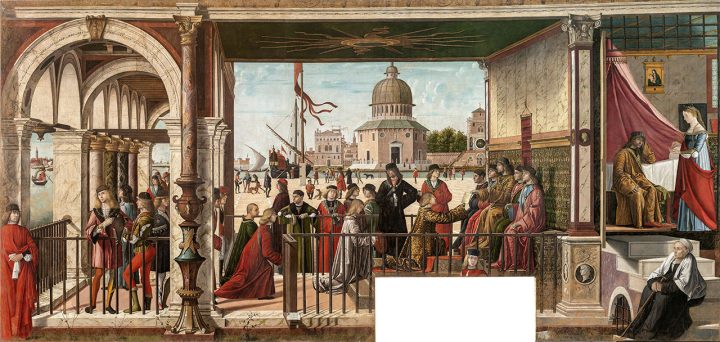
Vittore Carpaccio, St Ursula cycle – The arrival of the ambassadors, Gallerie dell’Accademia, Venice, end of 15th cent. In the background you can spot some sailboats
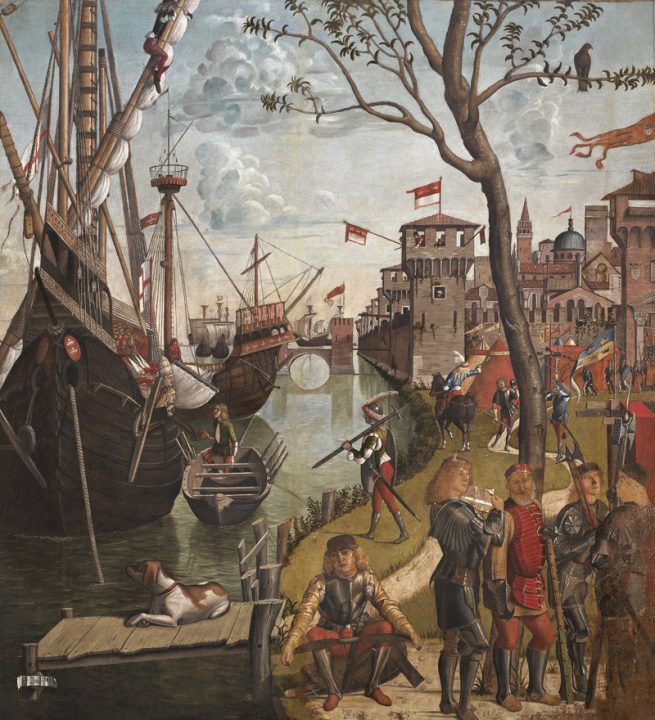
Vittore Carpaccio, St Ursula cycle – The arrival in Cologne, Gallerie dell’Accademia, Venice, end of 15th cent. Great details of the sails!
The Arsenale and the “velere”, the sail makers
Imagine thousands of workers regularly working in this huge area in Venice in the ancient times. Frederic Lane described the Arsenale as the first industrial district in Europe. The shipyard workers, the “arsenalotti”, were organized in such a way that helped rationalize the production chain. This sort of assembly line method can be observed in a map displayed in the Naval Museum in Venice, showing the Arsenale at the moment when Napoleon Bonaparte conquered Venice.
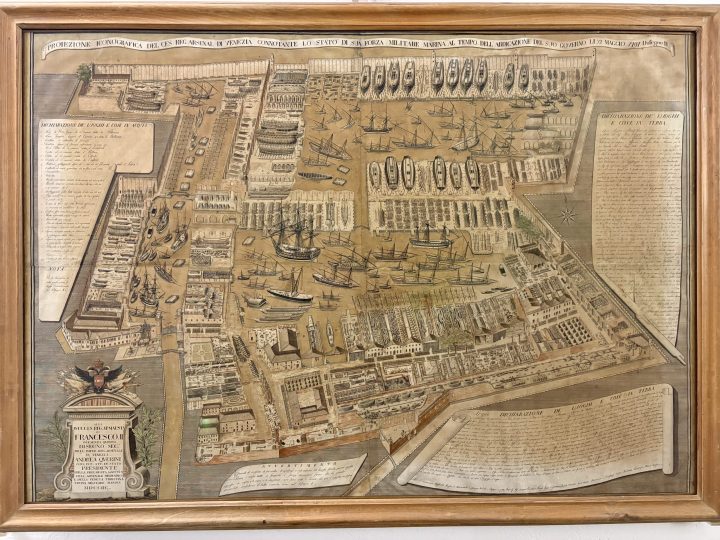
Map of the Arsenale in Venice dated 1798, Naval Museum of Venice
From wood to metal, from tar to cotton, linen and hemp… the materials delivered here would be used to build ships, masts, oars, artillery, ropes and sails. All profession performed by men, except for making sails.
Women making sails in the Arsenale
Making sails in the ancient Arsenale was in fact a profession only women performed. And not just making sails, but also confectioning the coats with which one would cover the gondolas and the boats for protection.
In the area of the shipyard under the jurisdiction of the Italian Navy you can find some buildings erected in 1537 near the submarine “Enrico Dandolo”. It was there where sails were once made and deposited. The construction underwent major changes in 1889 and it is today addressed as the Loggia dell’Ammiragliato —the loggia of the Admiral headquarters.
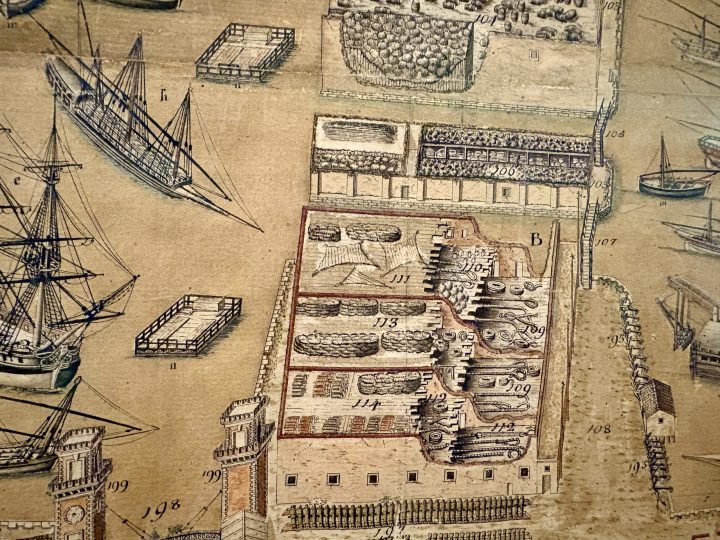
Detail of the sail section in the map of the Arsenale in Venice dated 1798, Naval Museum of Venice
The construction is quite simple and in the ancient document one can read the “velere”, the women making sails, worked there, so to be separated from the section of the Arsenale where men were employed. We talk about forty, also sixty women, although some mention 400 women.
They used very heavy fabrics, thickly woven. They cut and sewed the different sheets, reinforced the corner of the sail at its clew, the reef points and the borders. Of course, they also repaired the torn sails. For each different ship, they made different sails.
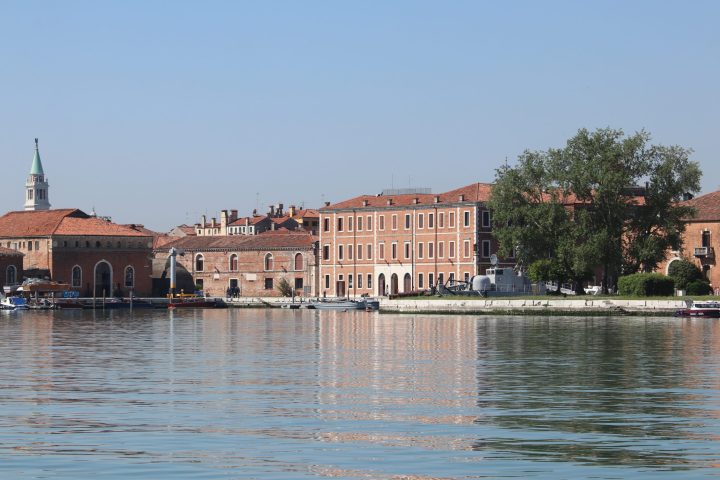
Within the Arsenal, the building where originally sail makers were working, view from the Tesa 105, Venice
Women in the “ospedali” taking care of the sails
After this first working phase, sails were then brought for the last touches to more women living in the “ospedali” of Venice, especially the Mendicanti and the Incurabili —charity institutions taking care of orphans, beggars and ex prostitutes.
Sails were then brought back to the Arsenale so they could be first bathed in salt water and finally dried in the sun so to avoid future mold. This is the part of the work men performed.
Quite interestingly, women were not employed because the work of making sails didn’t require physical strength. Actually, it was quite hard, but their pay was much smaller… which explains why men, who got better paid, were involved for the heaviest phases of the work only. Not just, women making sails in Venice were employed as non specialized professionals, which means they were not allowed to have their own guild.
And yet… In 1580 in a document at the Correr museum, a protest is mentioned. Several of the women making sails were widows with children to take care of and they hardly survived with the small pay they were earning. In this document we read the words of these women, complaining about the poor pay forcing them to leave the job, specifically they mentioned the number of the workers had shrunk ten times (from 300 to 30).
Sewing the sail, a painting by Joaquìn Sorolla at Ca’ Pesaro, museum of Modern Art in Venice, 1896
When you enter Ca’ Pesaro, the museum of Modern Art in Venice, you cannot but fall in admiration in front of the painting “Cucendo la vea” by Joaquìn Sorolla. Sorolla was a very talented and successful painter, born in Valencia in 1863. This large canvas was painted when he was still a young artist. He immediately received fame and honors. His scenes dedicated to workers and farmers are inundated with a warm Mediterranean light. Here we can see women sewing a large white sail in a garden of colorful flowers. We can feel the wind, hear their laughter, but also the sound of the waves along the port of Grao in Valencia.
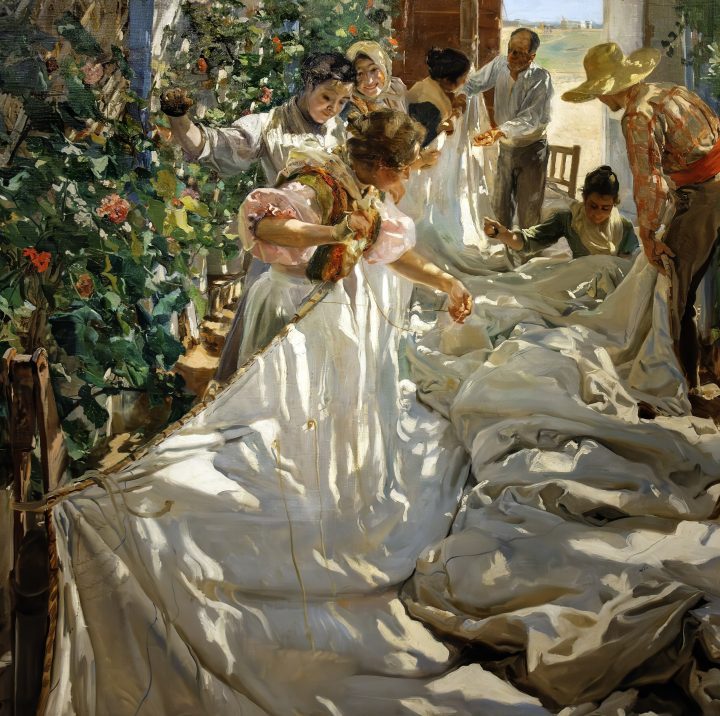
Detail of the painting by Joaquin Sorolla, Sewing the sail, Ca’ Pesaro Museum of Modern Art in Venice, 1896
It was exposed at the Biennale of Venice in 1905, after being shown in Paris, Munich and Vienna. The City Council of Venice decided to buy it, even if it was quite expensive for the time, around 11,000 lire.
Quite a jump from the real sail makers in the Venice and its shipyard to this artistic representation by an impressionist painter from Valencia, don’t you think?
Making sails in Venice today: Camoz by Camilla Morelli
Camilla Morelli moved to Venice to study at the University Ca’ Foscari and chose to stay after her studies. Her passion for the sea and for sailing shows a lot when you visit her laboratory in Santa Croce, where, just around the corner of Ca’ Pesaro, she shares a large space with other artisans and artists.
Years ago, when she started in 2013, her work as a sail maker brought her to cities nearby, such as Chioggia and Caorle, but then, fortunately for the city of Venice, she moved to Venice full time. Unlike large companies of the kind she experienced working with in France or in other Italian cities, her activity is to design bespoke sails and boat covers just for specific clients. In other words, strictly artisanal.
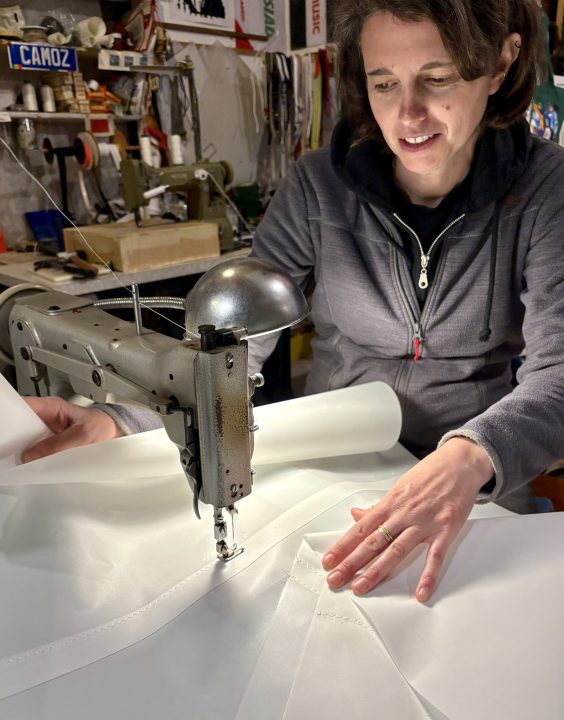
Camilla Morelli sewing a sail in her laboratory in Venice
Her experience has constantly grown throughout these years, restoring traditional wooden boats from Venice, learning about technical design, building new boats. She learned how to paint sails with the help of experienced artisans in Venice, too. She took courses, as well. And she was the only woman attending.
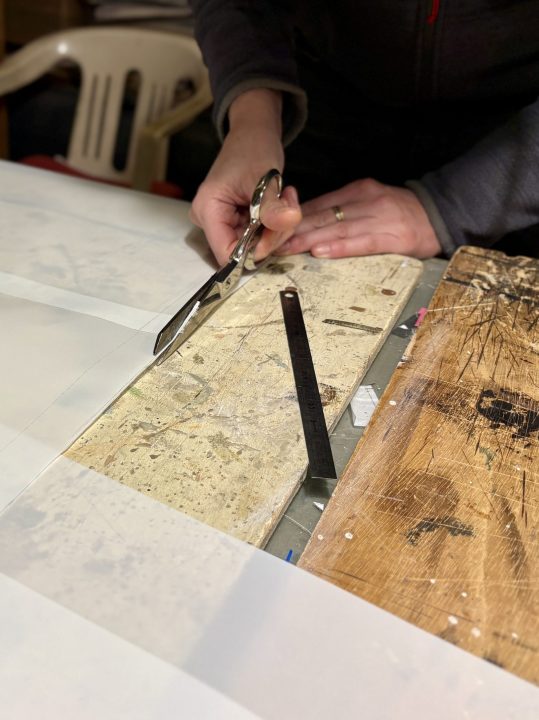
Camilla Morelli cutting a sail in her laboratory in Venice
A choice from the mountains to the sea (and lagoon)
From someone originally coming from Valtellina —Lombardy region immersed in the Alps!—, to have chosen an activity so much connected to the sea, the Venetian lagoon and sailing is a sign of deep love. She points out, it’s love for its nature and for the relationship you establish with water. A way to find yourself. And no, we are not talking about competitions or regattas.
Her approach is also environmentally careful. She recycles the remnants of her work and creates very joyful and functional objects, such as bags, money belts and purses, rucksacks. You can find on her website (camoz.it) some photos of her creations or purchase them when in Venice at the bookshop “Mare di Carta” specialized in maritime publishing.
A long, unconventional story that of women making sails in Venice, indeed, starting in the ancient times and swirling like in a whirlwind.
by Luisella Romeo
registered tourist guide in Venice, Italy
www.seevenice.it





Did Camilla Morelli make the sail for Cocola by any chance? Thanks for a very interesting article.
Grazie, dear Gail! Camilla Morelli has made the coat with which we protect the boat when we don’t use it. She is really gifted!!!