Lace tradition in Venice: a Venetian invention of the 15th century
Lace tradition was invented in Venice. By “lace”, I am not referring to embroidery, but that kind of art in which the pattern you design with a piece of yarn and a needle does not have any support to start from, no net, no textile framework.
The first time lace was mentioned in an official document was in a sumptuary law delivered in Venice, prohibiting the excess of money invested in female clothing. It was dated in 1476. The document mentions
ponto in aire si facto ad ago, come facto d’oro over d’arzento
which literally means “a point in the air, made with a needle, in gold or silver”.
Of course the law targeted women. No surprise. But the more you read about lace, the more you understand there is a lot of gender conflict in this story. Not that using lace, gold and silver to decorate part of your dress was a sign of virtue in an aristocratic republic as that of the Doges of Venice. Sobriety was a must.
Lace and Venetian gothic architecture
But if you look at the architecture of Venice just a couple of decades before, then why not thinking lace was a tribute to Venetian style? In 1442 the Doge’s palace was completed with its main door, the so-called Porta della Carta. The palace in this flamboyant gothic style must have impressed everyone: partially covered in gold leaf, it shimmered in front of all the ambassadors approaching the seat of the government.
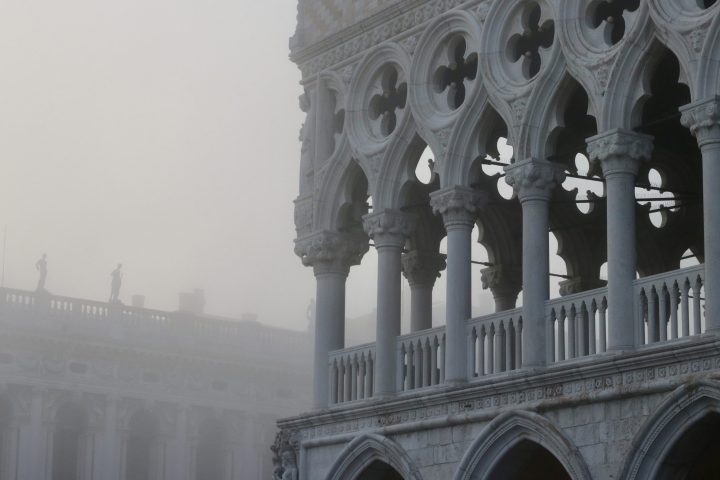
Corner of the Doge’s palace in a foggy day, St Mark’s square, 15th century, Venice
In the same years of the 15th century, Marino Contarini had finished to decorate the façade of his house on the Grand Canal with gothic pointed arches, colorful pigments and gold leaf. The gold leaf was so impressive that the house was known as the Ca’ d’oro —the house in gold. Even today, no more gold shimmering, it is still called so. Just the lace effect is left. Yes, lace in stone…

Ca’ d’oro, today Galleria Giorgio Franchetti, 15th century, Venice
It is true the time for the Venetian State was not the easiest and it required some severity: the Ottoman threat proved to be challenging, the Arsenale had to be re-enforced. No time for being frivolous. But how much harm can some lace do?
In the 15th century lace was still an applied art noble women in their palaces would dedicate themselves to. Educated women, surrounded by artistic beauty, looking out of the window at the city through these stone lace patterns, how could they not appreciate the chiaroscuro? Or the swirls and scrolls? The pointed leaves of clover? The reflection of the light from the canal on the stone? Lace reflected the way they watched Venice through the lens of gothic architecture.
Renaissance time: when lace was no longer just a hobby
In the late 16th century though, lace became something else. Lace was finally recognized as a decorative accessory on your garments you could not live without. This means it was necessary to move lace tradition in Venice from a hobby to a serious “industrial” production.
The dogaressa Morosina Morosini Grimani founded a lace maker laboratory in 1595 in Venice, near Santa Fosca, in the Cannaregio neighborhood. Not a bad location, considering that Cannaregio was the textile district of Venice. Lace would be also made in convents and in institutes such as the Zitelle or the Convertite on the island of Giudecca.
Bed linen, towels, table cloths on one hand. On the other, shirts, collars, the neckline along the décolletage, cuffs, handkerchiefs, a fan behind the head, sleeves and shoes… or, using bobbins, underwear: lace was everywhere. That’s when it turned into a major art you could export all over Europe.

Cuff, Venice, 17th century, Correr Collection, Lace Museum in Burano

Flounce, Venice, 17th century, Correr Collection, IRI Jesurum, Lace Museum in Burano
Even the French King Louis XIV loved it and invited lace makers from Venice to his court in 1665. By the way, the Court of the Council of Ten found a “nice” way to convince the lace makers to come back: if they didn’t make there way back to their “beloved” Venice, their families would be imprisoned and they would be threatened to be killed. Nice touch.
Lace: a profession without a professional recognition
Too bad that in Venice never a guild was allowed to protect this profession. Basically, it was not recognized as such and many of the lace makers could be considered “slaves” for the lack of recognition and the high level of exploitation. In Venice where almost all arts and crafts were ruled and protected via the professional guilds, it is quite remarkable that this exclusively female art was not allowed to arrange a brotherhood — we should say a sisterhood.
The story of Bartolomeo Cargnoni at the Derelitti
An interesting story is that of Bartolomeo Cargnoni, a Venetian merchant who ran a very profitable activity in producing textiles in silk and gold (or silver) yarn. His father had sold feathers and hair decorations, the logo of the family business was an ostrich. Incredibly wealthy, Cargnoni at his death in 1662 left a major donation to the Ospedaletto, an orphanage in Castello. In fact, during his whole career, he had exploited the lace makers working for him.
The façade of the church connected to the orphanage, called Santa Maria dei Derelitti, shows the bust of this generous man and above, not so visible, the representation of an ostrich. Here you can see the portrait by Daniel van den Dyck kept in the offices of the IRE, also the headquarters of “I Gioielli di Venezia”:

Daniel van den Dyck, Portrait of Bartolomeo Cargnoni, 1663, I gioielli nascosti di Venezia, Venice
Strictly controlled by more women, the lace makers worked seven hours in the winter, eight hours in the summer, every day, earning just enough to pay for their stay in the institute, the rest for the institute.

Unknown painter, Portrait of Angela Adorni Sbardellini at the age of 20 when she was the priora of the Zitelle institution, ca. 1660, Venice, Gioielli Nascosti di Venezia
Orphans, ex prostitutes, young poor girls: certainly not someone who had the possibility to protest so to achieve better working conditions. If lace tradition in Venice was taken in high consideration, the voice of the lace makers didn’t get beyond the walls of those institutes.
And what about Burano? A noble woman, an elderly lady and a queen
It is after the unification of Italy and the annexation of Venice in 1866 that lace tradition in Venice received a lot of attention. In 1871 a member of the Italian parliament described the island of Burano as struck by “squallidissima miseria” (dreary misery). Some noble women such as Andriana Zon Marcello convinced Queen Margherita di Savoia to support a school for lace in 1872. Cencia Scarpariola instructed the first teacher and off you go. Set in Burano, the school which ceased its activity in 1970 is right now the seat of a great museum of lace on the island.

Margherita di Savoia portrayed with her son, the prince of Naples, Lace Museum in Burano, Fondazione Musei Civici

Street dedicated to Cencia Scarpariola: she was the elderly lace maker who taught the first teacher at Burano School of Lace, Burano

Advertisement for the Lace School in Burano and lace shop in St Mark’s square, Venice, Fondazione Musei Civici Veneziani, 20th century.

Umberto Moggioli, Lace makers in Burano, late 19th century, Lace Museum in Burano
Two years later Michelangelo Jesurum started his lace company. In 1877 more schools in Pellestrina, Venice and Chioggia.
Lace tradition today in Venice, Pellestrina and Burano
Nowadays, in a society where the difference between mechanical and hand-crafted work is not appreciated by everyone, authentic hand-made lace is not just hard to find, but it risks to disappear or to lose high quality. Noteworthy actions are taken in its promotion by A place of wonders, the association entitled to Andriana Zon Marcello as well as the A.C.S. “Murazzo” Merlettaie Pellestrina.
A special prize is also that arranged every year by Fondazione Musei Civici di Venezia. You can read more about the National Competition for Needle Lace and Bobbin Lace at this link:
https://museomerletto.visitmuve.it/en/a-lace-for-venice-competition/lace-for-venice-2026/competition-2026/
In 2024 an association was founded under the name of “Associazione Merletto di Burano”. Their goal is to get for Burano lace the Protected Geographical Indication (PGI) from the European Union.
Our wish is that lace makers and the historical and artistic value they transmit with “a thin yarn in the air” will finally get the recognition they deserve.
by Luisella Romeo
registered tourist guide in Venice, Italy
www.seevenice.it