


Mariano Fortuny y Madrazo acquired Palazzo Pesaro degli Orfei starting by the end of the 19th century. In a few years the whole gothic building would become his property. In the rooms on the upper floor he would work. Downstairs, on the so-called “piano nobile”, the noble floor, he chose to reside with his muse and partner in life and work, Henriette Nigrin.
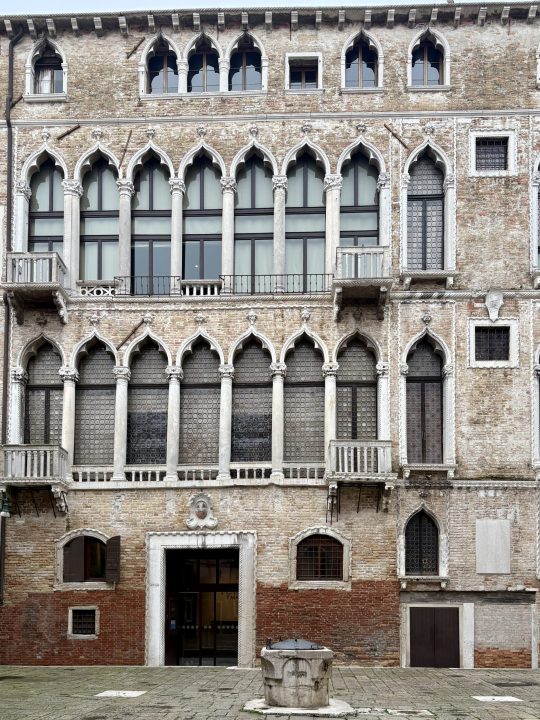
Façade of Palazzo Pesaro degli Orfei, aka Fortuny Museum in Venice, 15th century
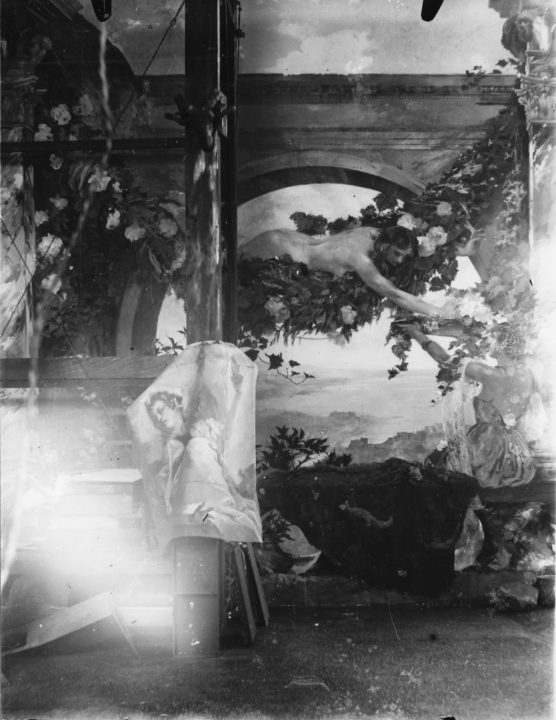
Mariano Fortuny’s atelier in a photo of the 1920s, copyright ©️archivio fotografico fondazione musei civici di Venezia
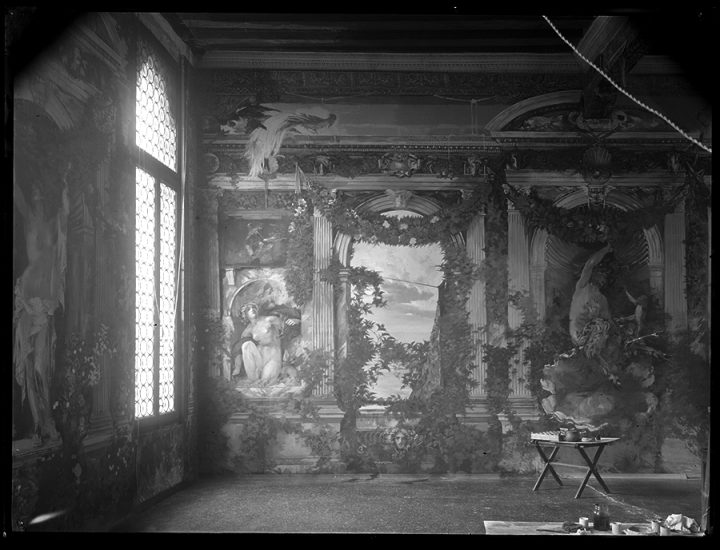
Mariano Fortuny’s atelier in a photo of the 1920s, copyright ©️archivio fotografico fondazione musei civici di Venezia
Palazzo Pesaro degli Orfei
Mariano Fortuny and Henriette Nigrin certainly knew the history of this Venetian palace, the largest gothic palace in the whole city. It was designed in the 15th century for the Pesaro family, the branch of Benedetto’s, the same one who hired Giovanni Bellini for the family tomb in the franciscan church Santa Maria Gloriosa dei Frari. That large residence, the one still today featuring the longest “portego” in Venice, had then changed. In the late 18th century it housed the headquarters of a printing workshop, then music academies and finally several apartment units.
Why not therefore keeping the multifunctional nature of the building also when Mariano and Henriette chose to live there?
Mariano Fortuny y Madrazo and his work in Venice
Fortuny and Nigrin used the building to work, especially on textile production. But that was not the only occupation you would witness if you went there. Photography kept Fortuny very busy. He even tried to improve the camera to take panoramic photos. Not to mention engravings, copper plates, stage lighting projects etc. Fortuny was an inventor of machines, too. He was always very careful in getting the patents to protect the copyright of his inventions.
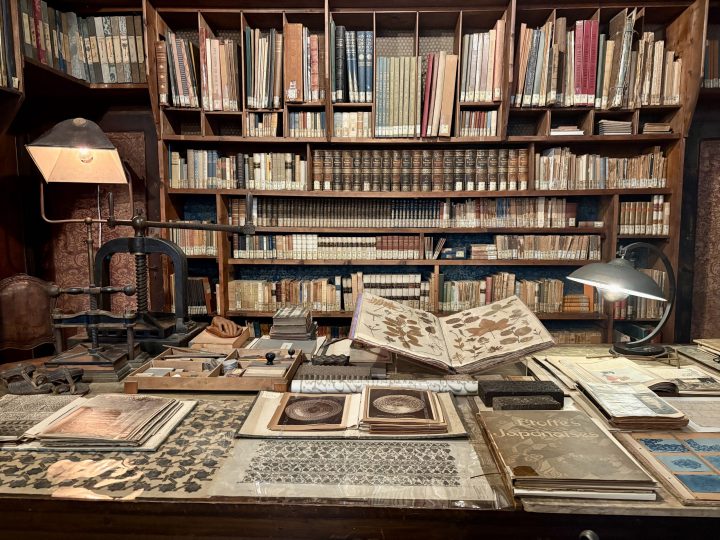
Library of Mariano Fortuny, Venice
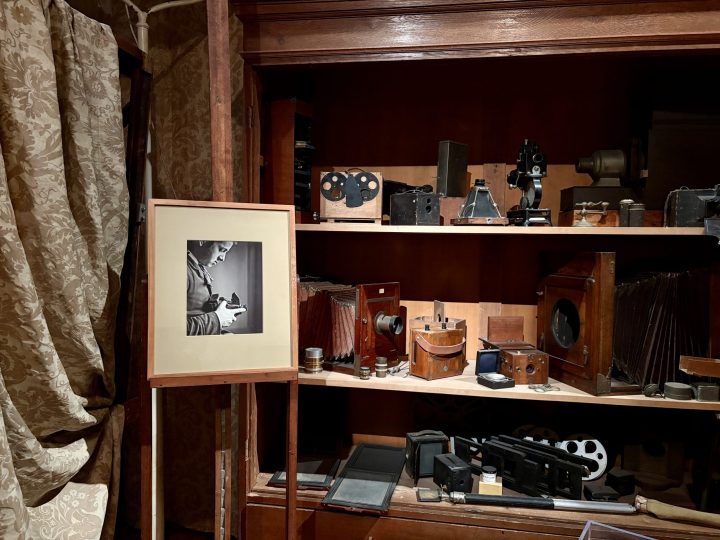
Photo equipment and Mariano Fortuny photographed while taking a photo, Fortuny Museum Venice
While you visit the Fortuny Museum today in Venice, you will justly be attracted by the starring delphos dresses. The sensuality of the pleads of those dresses, at the same time modern and archaic, their sinuous lines, delicate and seductive shades of colors.
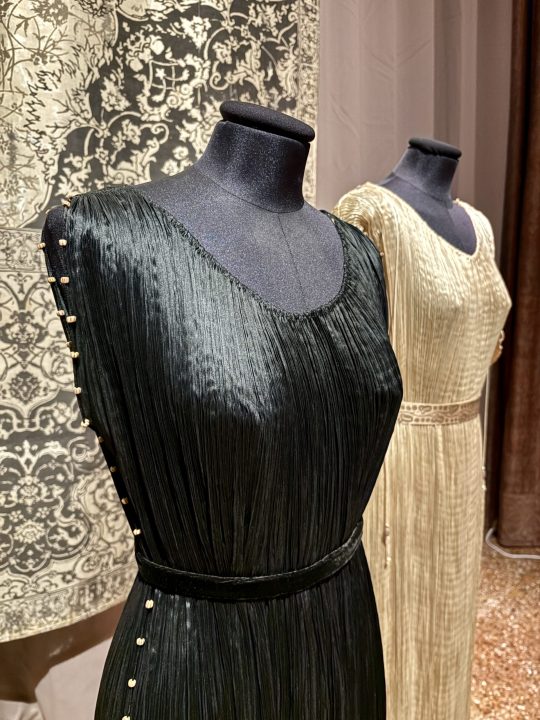
Black and white delphos dresses in Fortuny Museum, Venice
Yes, of course. You will love the gallery of black and white photos.
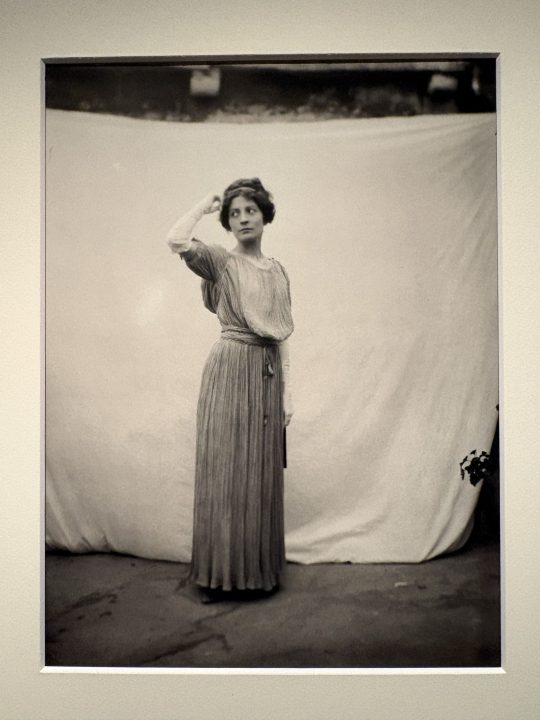
Henriette Nigrin trying a prototype of the Delphos dress, photograph by Mariano Fortuny, Venice
You will enjoy his paintings, also designing the scenes of Wagner’s opera.
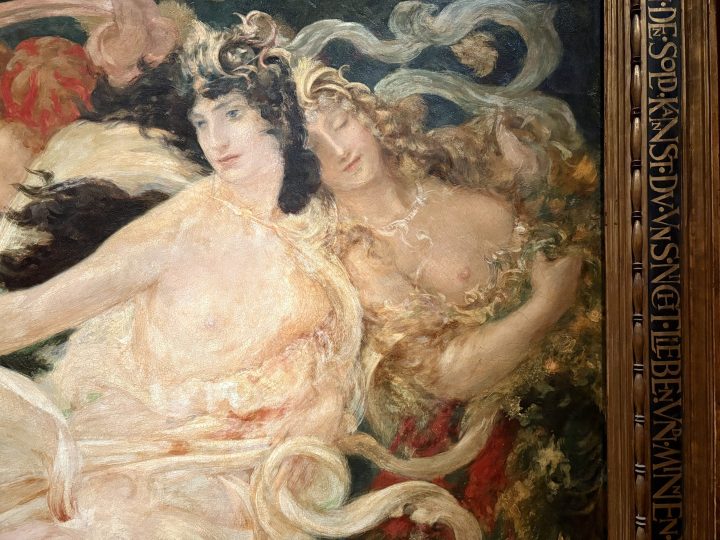
Flower Maiden, Painting by Mariano Fortuny, 1896, detail
But there will also be another breathtaking place, i.e. his painting atelier.
The atelier: a space decorated by Mariano Fortuny y Madrazo
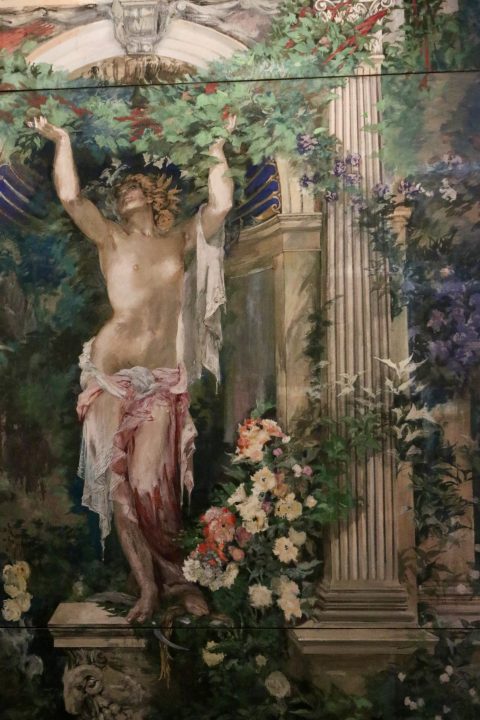
This is not just the space where Fortuny painted. In this very atelier, at the burst of WW1, Fortuny started a new project, something that kept him busy for the rest of his life, until 1949. A project he left incomplete. Basically, he started designing his private space for creativity, painting all the walls as if it were the stage of a theatre.
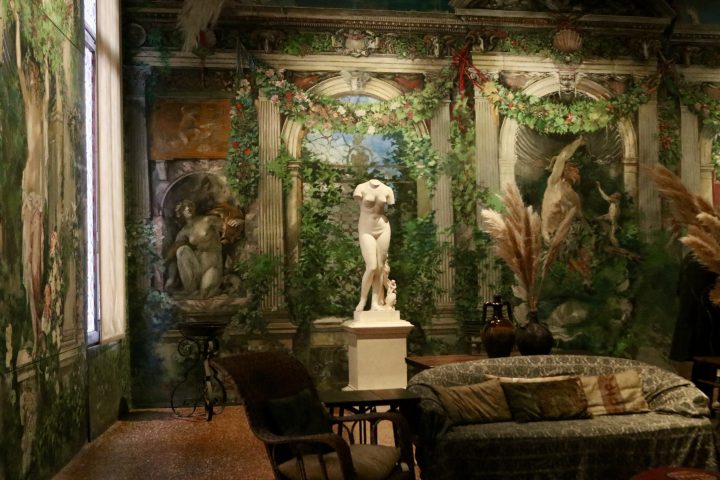
A view of a corner in Mariano Fortuny’s painting atelier in Venice, 1915-1945
The atelier in Mariano Fortuny’s palace is in fact a magical place. Imagine a room where walls are completely covered with canvas painted as if it were wall paper for quite a large surface, 140 sqm (around 1500 sqft). Here, you will move around as if you had entered a fairy tale and you were the actors not sure which role to interpret.
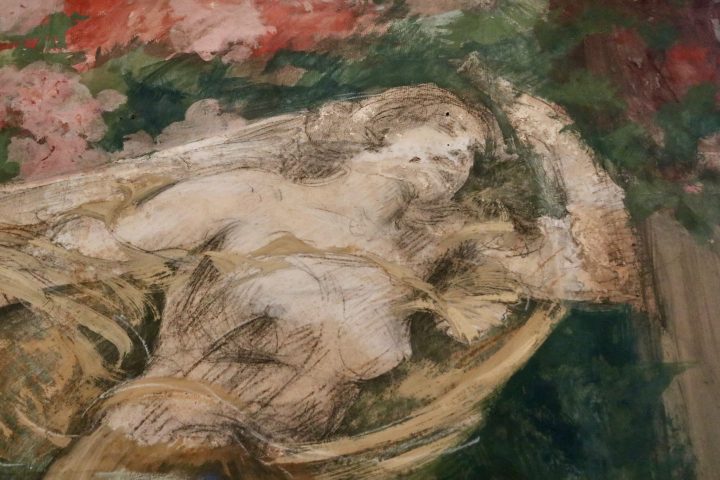
Unfinished detail in Mariano Fortuny’s painting atelier in Venice, 1915-1945
Do you remember when Alice steps into her wonderland?
Painted walls indoors
Mariano Fortuny y Madrazo certainly had in mind a long tradition in art and villas.
In the residences of the Roman emperors and high society members, the use of frescoes to decorate the inner rooms aimed at creating fantastic landscapes. The representation had to be life size. Birds, plants: these painted gardens were placed next to real ones, which you would see through the windows. So your eyes would shift from a trompe-l’oeil to real with no solution of continuity. A great example is the triclinium of the villa of Livia, Emperor Augustus’ wife along the Via Flaminia. The frescoes of her villa were eventually detached and they are now visible at Palazzo Massimo in Rome.
In the Renaissance the Roman tradition had obviously been recuperated. Regarding Venice, noble patricians would hire artists of the kind of Paolo Veronese and Giambattista Zelotti for the frescoes and trompe-l’oeil effects in their prestigious villas on the mainland. A revived attention to agriculture and to life in the countryside had brought many to representing landscapes inside their homes, together with ancient mythology and biblical stories.
The atelier of Mariano Fortuny y Madrazo as a pleasure garden
Indeed even in Mariano Fortuny’s atelier you can feel the need to create a fantasy and pleasure garden. There is however a unique sense of exoticism and sensuality which appears in his atelier.
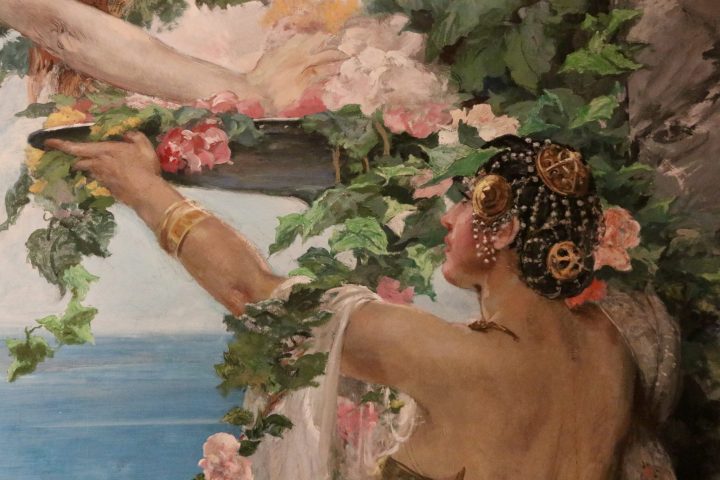
Oriental odalisk in Mariano Fortuny’s painting atelier in Venice, 1915-1945
Mystical symbolism is the artistic movement Fortuny shows devotion to.
Mystical and sensual at the same time…
Naked women with their long, soft blond hair swing on festoons of plants and flowers. Fragile but also “femme fatale” women surround and yet ignore us, while statues of satyrs, Venus and colorful parrots, white peacocks, monkeys appear in between the plants in full bloom.
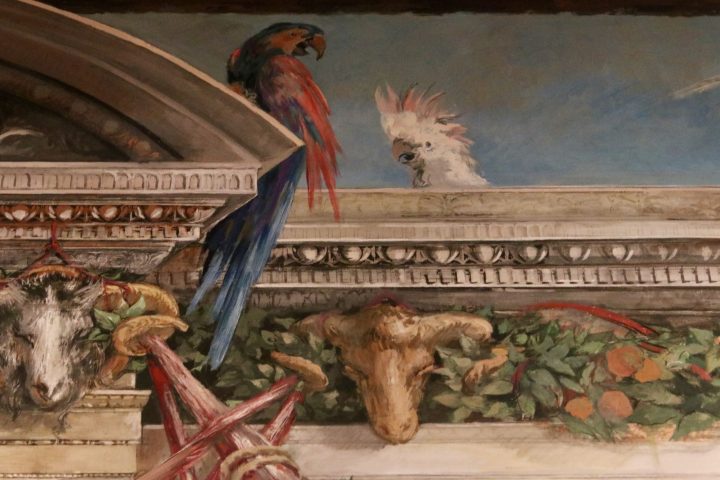
Parrots in Mariano Fortuny’s painting atelier in Venice, 1915-1945
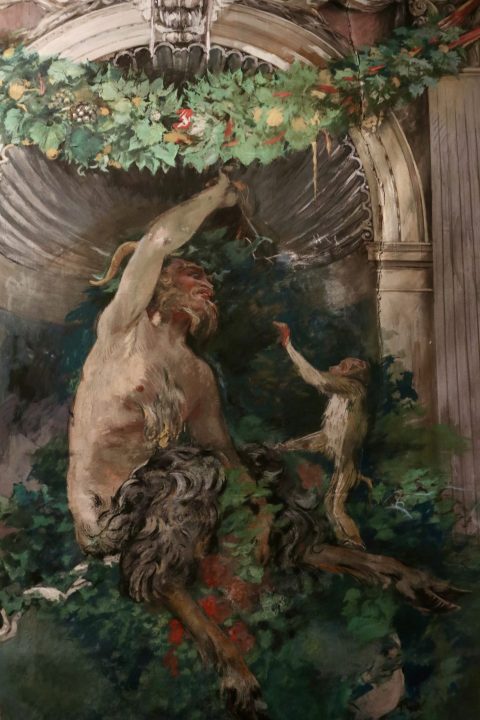
Satyr and monkey in Mariano Fortuny’s painting atelier in Venice, 1915-1945
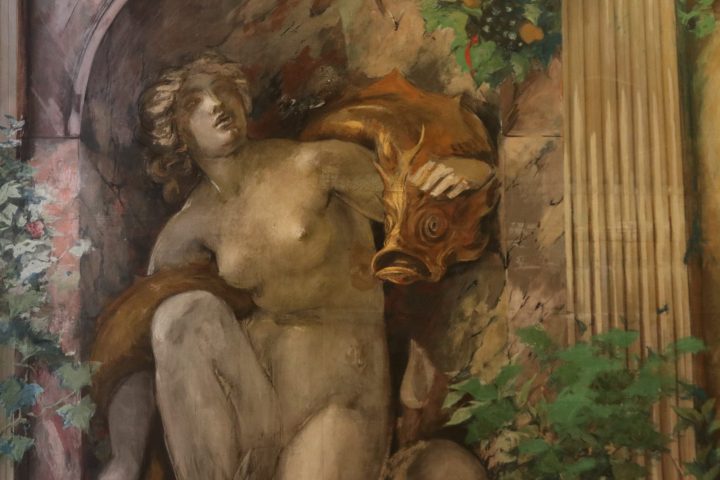
Sea creature in Mariano Fortuny’s painting atelier in Venice, 1915-1945
Landscapes bring us to lake visions, such as Lake Como or even to the Amalfi coast, some Mediterranean Sea visions. The light is definitively Italian.
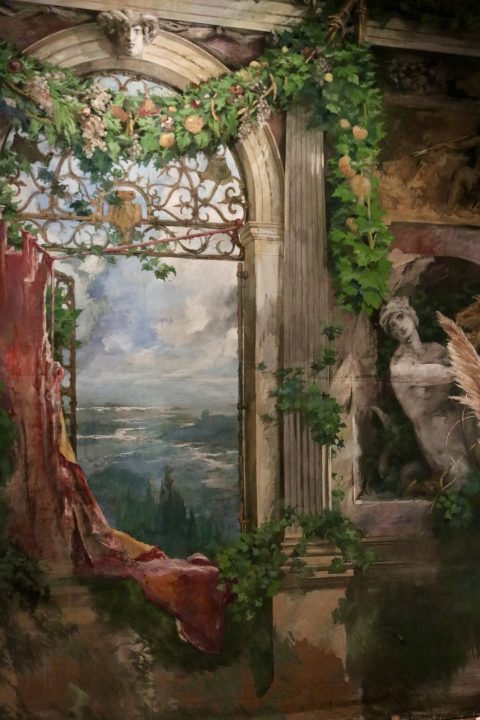
Roman ruins and landscape in Mariano Fortuny’s painting atelier in Venice, 1915-1945
When you visit this atelier, you cannot forget the influence of a dear friend of Mariano Fortuny’s, Rogelio de Egusquiza. Rogelio was the painter who moved into the studio which Mariano Fortuny’s father had opened in Rome. Not just. It was thanks to this artist that Mariano Fortuny learnt about Richard Wagner. If this atelier is not a theatrical study for an opera by Wagner, well, we are very close.
At the same time, Mariano likely saw the impressive work by Giulio Aristide Sartorio for the Central Pavilion of the Venice Biennale in 1907, on show last year at Ca’ Pesaro, the museum of modern art in Venice.
A private boudoir for phantasy and creativity: Mariano Fortuny y Madrazo’s atelier is a true, heart felt tribute to the city of Venice welcoming him with his eclectic life style where art is everywhere and you cannot live without.
by Luisella Romeo
registered tourist guide in Venice, Italy
www.seevenice.it




Thanks for this post Luisella. I still remember our first visit there with you. A big reason for our buying MUVE Friend cards each year was so we could go back again and again to this Palazzzo – so many interesting things to see.
Such a great piece of advice! This is the sort of museum which you will enjoy every time you get in. I also believe Mariano Fortuny would have not created this much if he had not lived in Venice. So it’s great to see the connection between him and the city he chose to live in.