Angelo Barovier and his cup in polychrome enamel and gold glass
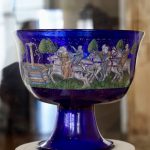
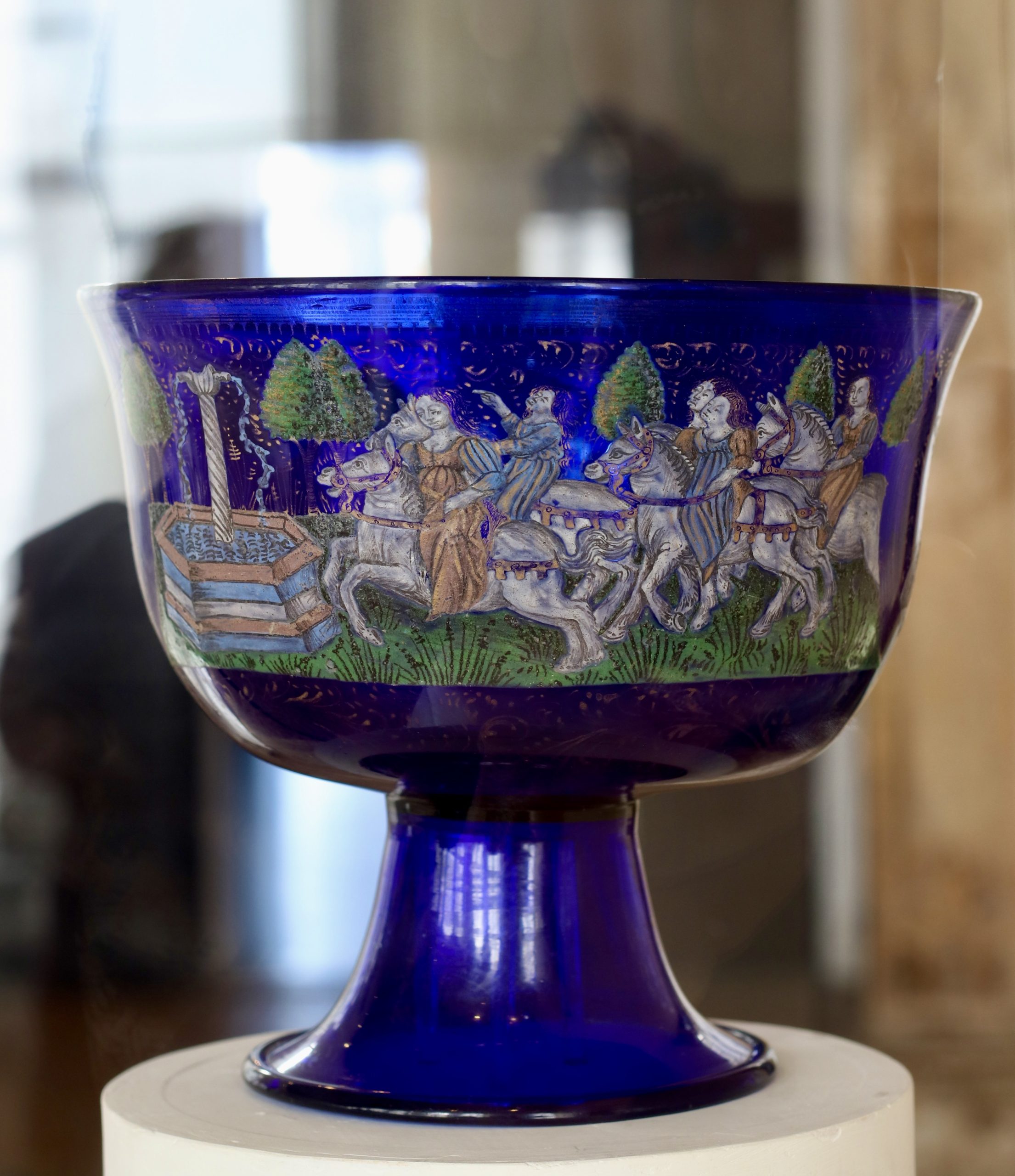
In Murano the Glass Museum hosts one of the most exquisite glass artworks ever, the so-called Barovier Cup. The piece dates back to the middle of the 15th century (1460-70) and it is attributed to the father of Murano glass, Angelo Barovier, whose daughter, Maria Barovier, is also very well known as the creative master for glass beads.
The Barovier Cup likely was a rich nuptial gift. This cup stands out in the center of the main room of the museum in its own showcase. In the frieze all around the cup you see portraits of a couple, knights and ladies freely riding their horses, the fountain of youth. The accurate polychrome enameled decorations on the cobalt blue base deserve attentive observation and patience to be appreciated. But what you will also notice is the presence of gold decorations, embellishing the final result with a typical Venetian taste.
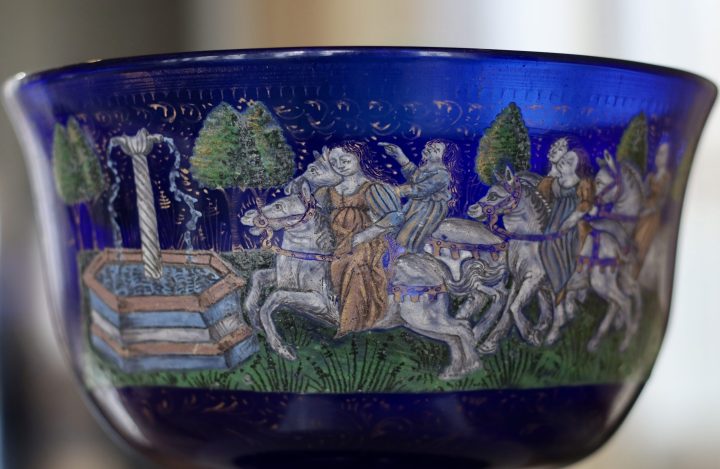
Fountain of life and youth with parade of riding knights and ladies painted in polychrome enamel and gold; detail from Barovier Cup, middle of the 15th century, Venice, Murano Glass Museum, detail
Glass and gold: is there anything else more Venetian than these elements?
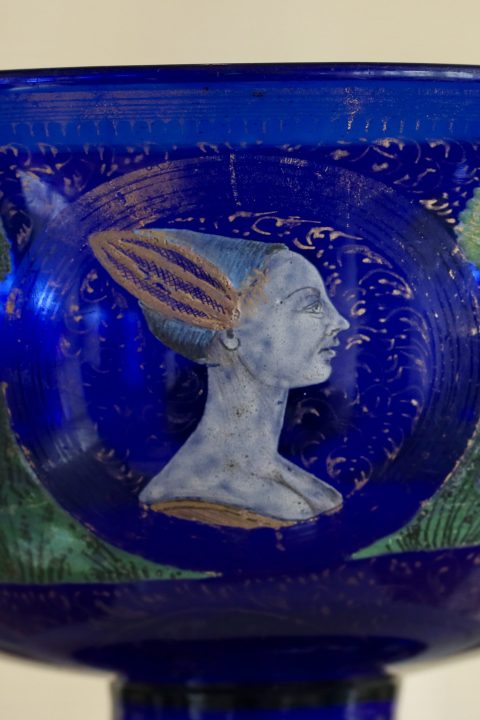
Woman painted in polychrome enamel and gold; detail from Barovier Cup, middle of the 15th century, Venice, Murano Glass Museum, detail
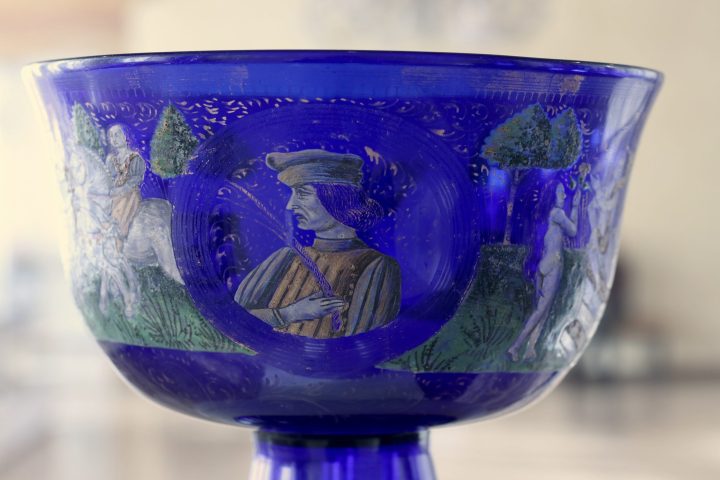
Man painted in polychrome enamel and gold; detail from Barovier Cup, middle of the 15th century, Venice, Murano Glass Museum, detail
Gold glass: which techniques?
The question regards also the techniques used by Angelo Barovier. According to Aldo Bova (2010), there are two different techniques used to decorate this cup in gold.
Barovier applied gold with a brush, using a mix of gold powder and likely borax. For different details, Barovier instead used the technique of gold glass, which means gold leaf was placed on glass, using some kind of mordant and then engraved, applying the sgraffito technique. Here are more examples:
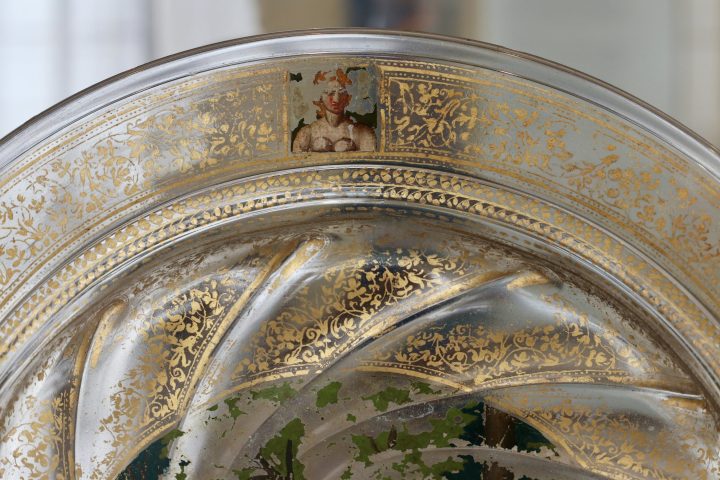
Rear side of a plate decorated in enamel and gold painted on the back, second half the 16th century, made in Venice, Murano Glass Museum
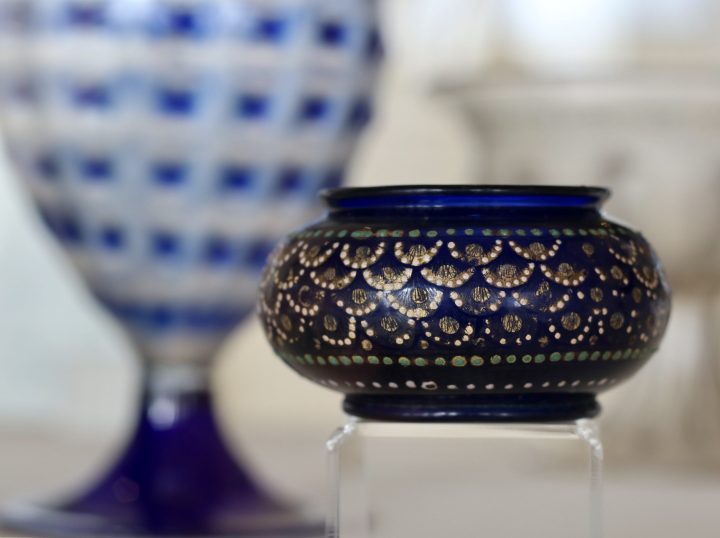
Blue glass saltcellar with engraved gold leaf scale decoration and fusible polychrome enamels, Venice, beginning of the 16th century, Murano Glass Museum
A comparison with panel painting in Italian art of the 15th century
In this wonder of Venetian early renaissance therefore glass is treated as panel painting. In the Correr Museum there are a couple of panel paintings depicting stories from Boccaccio’s Decameron resembling the Barovier Cup in style and motifs.
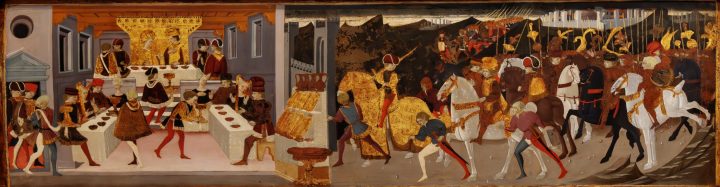
Apollonio di Giovanni, Stories of Alatiel (wedding feast), ca. 1460-65, Dowry chests, Correr Museum Venice (source is Wikimedia Commons)
Or in the church of San Trovaso, you can admire an artwork by Michele Giambono with similar artistic ideals:
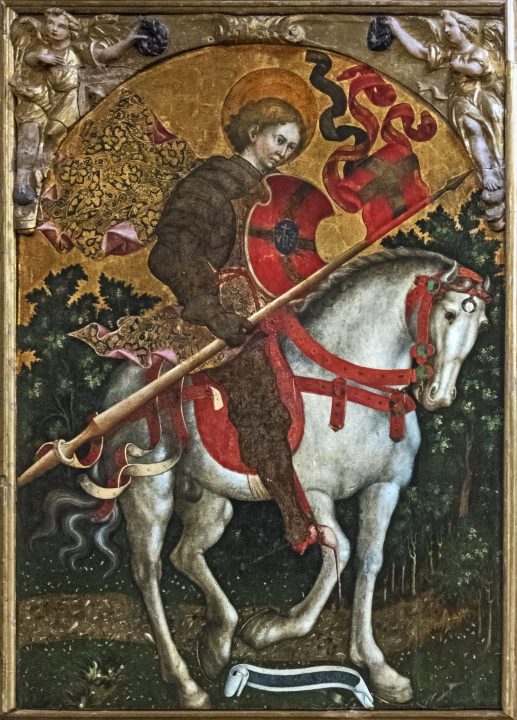
Michele Giambono, St Chrysogonus on Horseback, 1446, Church of San Trovaso, Venice
Gold glass or gold sgraffito in the history
Gold glass or gold sgraffito, however, was not a technique that was invented in Murano. In paleo-christian glass, dating to the 3rd-4th century AD, you can find at the bottom of drinking glasses some gold leaf engraved between two layers of glass.
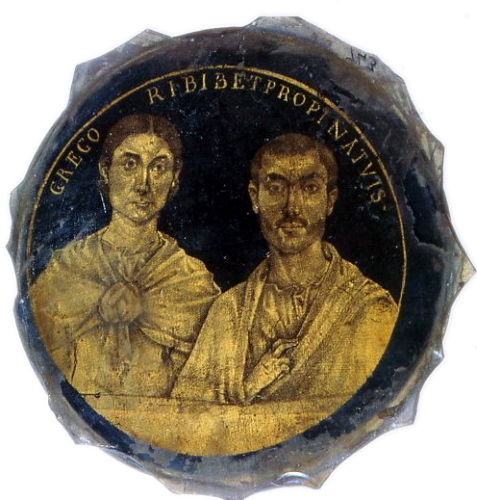
Gold-glass portrait of husband and wife (Biblioteca Apostolica Vaticana, Museo Sacro, Inv. no. 743)
This particular technique is also known as double-gilt glass.
After preparing the bottom of a drinking glass and letting it cool down, you would then apply gold leaf using some gluing substance. With an ivory point you would then engrave some pattern. Afterwards you would need to re-heat the piece to blow over the rest of the goblet. In this way, the gold sgraffito would be encapsulated within two layers of glass.
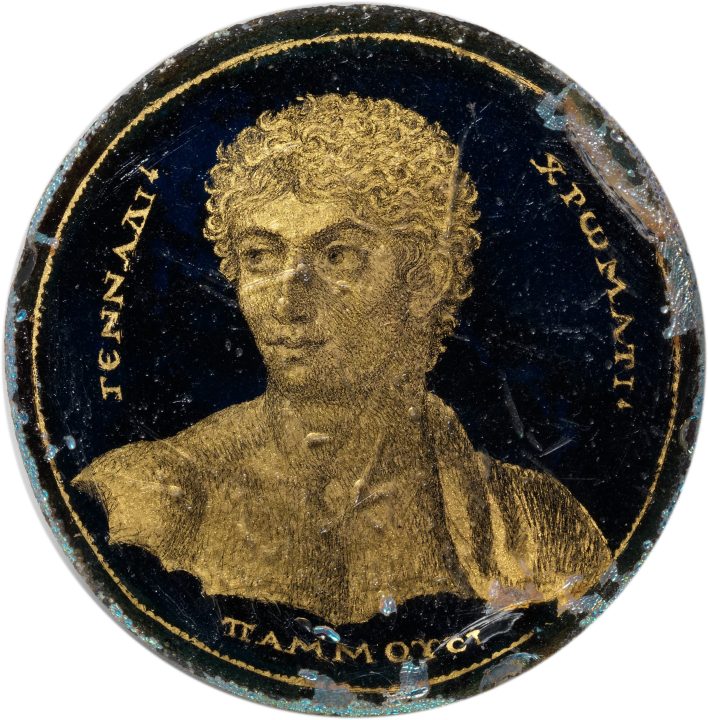
Gold glass medallion of a youth named Gennadios, who was “most accomplished in the musical arts”. Probably from Hellenized Alexandria, Egypt, c. 250–300, Metropolitan Museum di New York
This is slightly different from Barovier cup where the gold is not trapped within two layers of glass. But I guess, the Barovier cup was not meant to be washed too often…
The family Toso Borella in Murano and their gold glass
Somehow, gold glass was not so present in Murano production until in the late 19th century the Venetian-Muranese family Toso Borella proposed it again. And still does nowadays.
The name of the family Toso is quite well spread in Murano. You will then find different branches. The family Toso Borella has been present in Murano since the 14th century. Right after glass furnaces were transferred from Venice to Murano, thus becoming the glass industrial district, Toso Borella was there. In the early 17th century when the gold book of Murano families establishing who was entitled to be glass makers, Toso Borella was also featuring with its coat of arms.
Angelo and Francesco Toso Borella
It is in particular with Angelo and Francesco Toso Borella (1846-1905) that the family excellence in enameling and gilding glass reached international recognition.
In 1900 Angelo Toso Borella participated to the international exhibition in Paris, receiving the silver medal. Then his brother Francesco decorated 1100 drinking glasses for the Italian Queen Margherita. In 1904, across the ocean, at the World Exhibition in St Louis, Missouri, there would be a cup in glass by Francesco Toso Borella: that was the exact replica of an ancient cup discovered under the rubble of the Bell Tower in St Mark’s square after it fell in 1902. The collapse of the bell tower in Venice had shocked the world, that cup must have been quite a piece to admire!
Also Vittorio, Francesco Toso Borella’s son, excelled in the art of decorating glass in the Art Nouveau style.
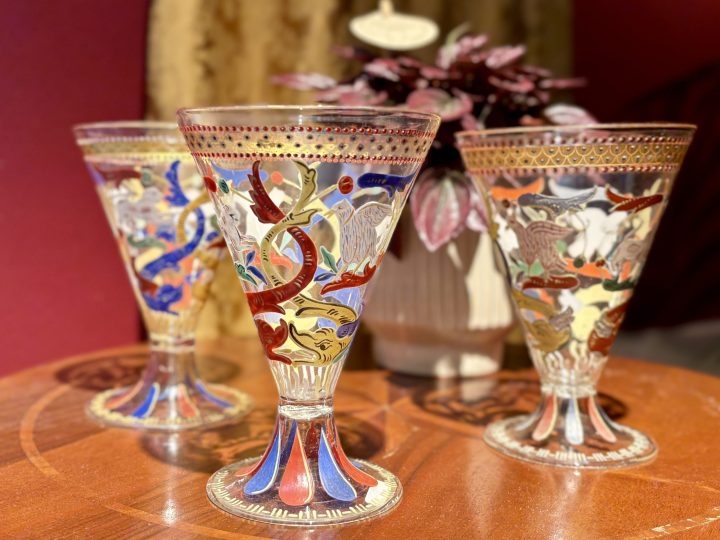
Goblets attributed to Vittorio or Francesco Toso Borella, Murano – Riccardo Toso Borella’s private collection
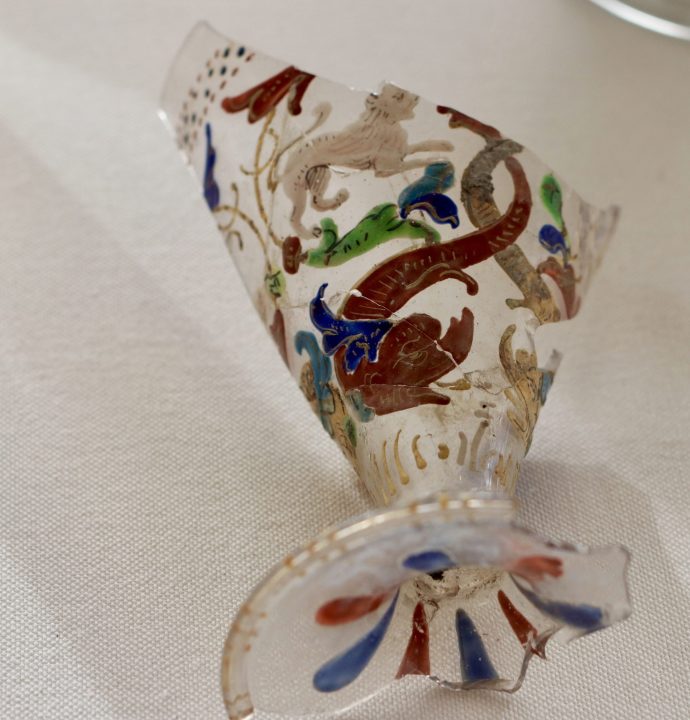
This is the original goblet found under the rubble of the bell tower in St Mark’s square, dating back to the beginning of the 16th century, which Vittorio Toso Borella copied, Glass Museum in Murano, Venice
Marco Toso Borella and his exhibit at the Glass museum in Murano
Today Marco Toso Borella (born in Murano in 1962) has received the privilege of exhibiting his gold glass artworks at the Glass Museum in Murano —visible until the end of March, 2027. You can admire his work “Via Crucis” at the church of Santa Maria e Donato and he is mentioned as the renowned artist for Gold Glass in Paul Getty “Artist’ Techniques and Materials” (2004): https://mtbarts.it/
Riccardo Toso Borella: when a young artist experiments with gold glass
I met Marco’s son, Riccardo Toso Borella, and I was really impressed with the work by this young artist. Riccardo is the only one in his generation to pursue an artistic research in gold sgraffito with a modern as well as ironic approach.
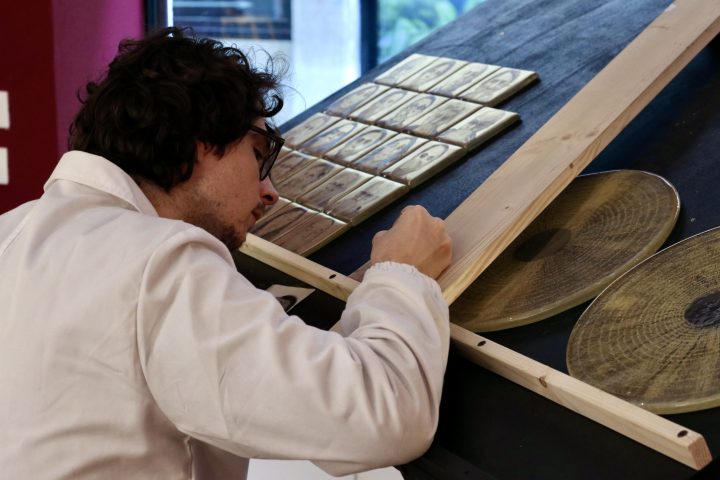
Riccardo Toso Borella at work with his metal point etching gold for Bubble, 2026
But do not expect to find him in Murano. His studio, BIBE Art Gallery & Lab, is in Venice, not too far from the Ca’ d’oro, Giorgio Franchetti Gallery museum. Who knows if it’s the vicinity of what used to be a palace covered in gilded marble slabs which also inspires him?
The glass panes he uses are made in Murano. Gold leaf is from Florence. Once the gold leaf is applied on glass, Riccardo’s hands start etching the gold with great patience and concentration, employing tiny needles and metal points, also little scalpels. The movement of his hand is slow, accurate and steady. No mistakes are accepted…
Where the gold leaf is removed by etching, a picture comes alive and, contrasting with a dark background, you see the pattern, also in 3D effects when glass panes are multilayered. Afterwards the piece and its etched gold picture gets fired in a kiln, partly fusing the gold to the glass so that it can no longer be modified.
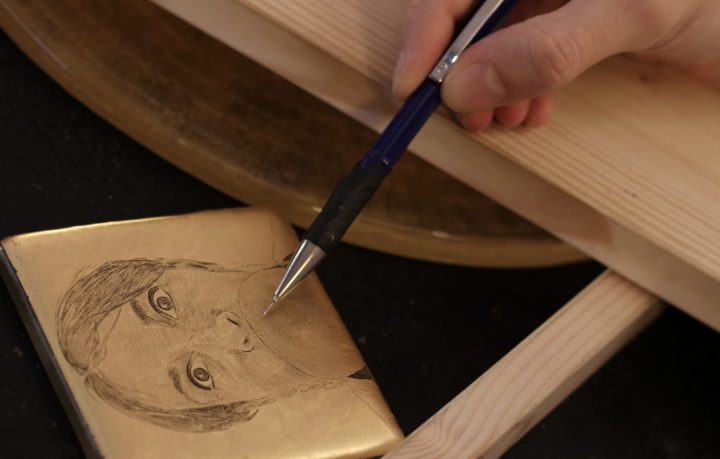
Riccardo Toso Borella at work with his metal point etching gold for Bubble, 2026
Gold glass to convey a message and focus on a concept
Among his works, you can admire a collage of portraits of friends, supporters and family members, all blowing a bubble. While they remind us of glass blowers, the bubble is like an echo chamber, beyond the artist’s life and becomes a metaphor for our society. Delicate and fun.
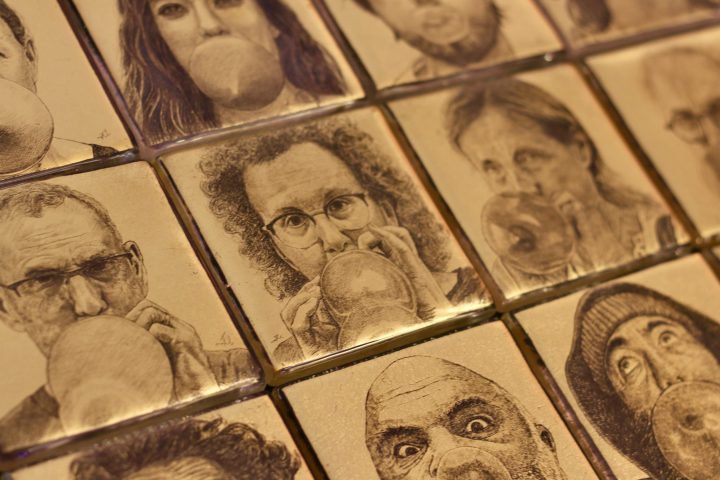
Detail of Bubble, 2026, artwork in gold glass by Riccardo Toso Borella – in progress
On the wall you can see an accurate view of St Mark’s square, the Doge’s palace and its monumental heritage. It could be a painting by Canaletto in gold, if it weren’t for a crane busy with the restoration of a hotel along the waterfront. Venice and its immobility, as attracting as an ever lasting image can only be and yet modern —get closer to read what the words on that crane say, btw…
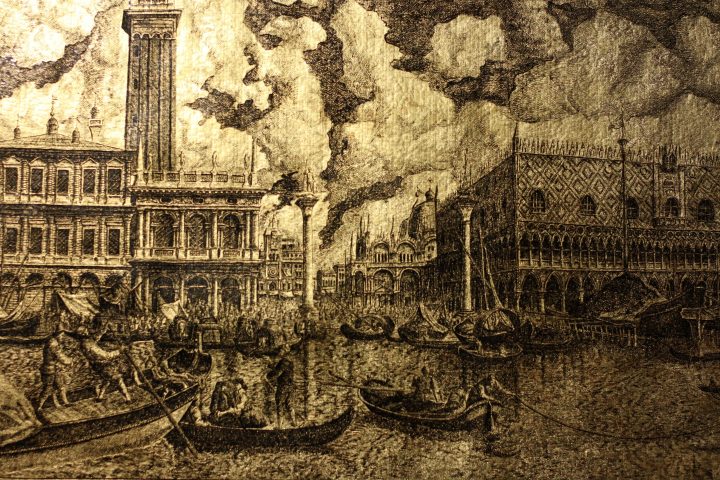
Detail of An Icon of Venice, 2025 – artwork in gold glass etched by Riccardo Toso Borella
More work you can admire in his Venetian lab:
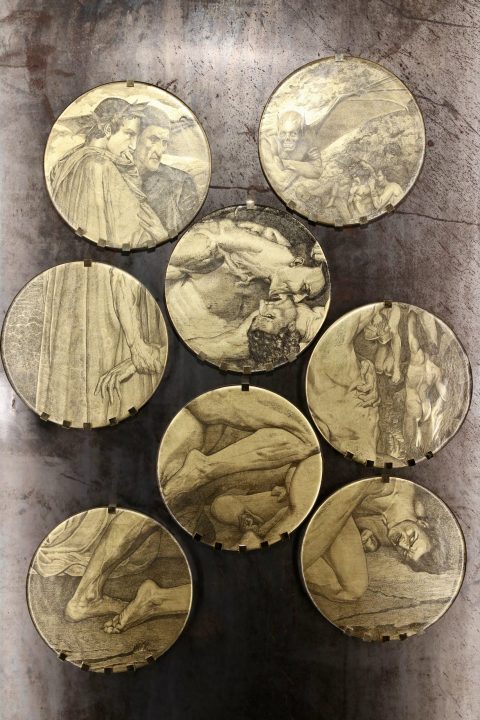
Hell 1953, 2025-26 – eight medallions in gold glass etched by Riccardo Toso Borella
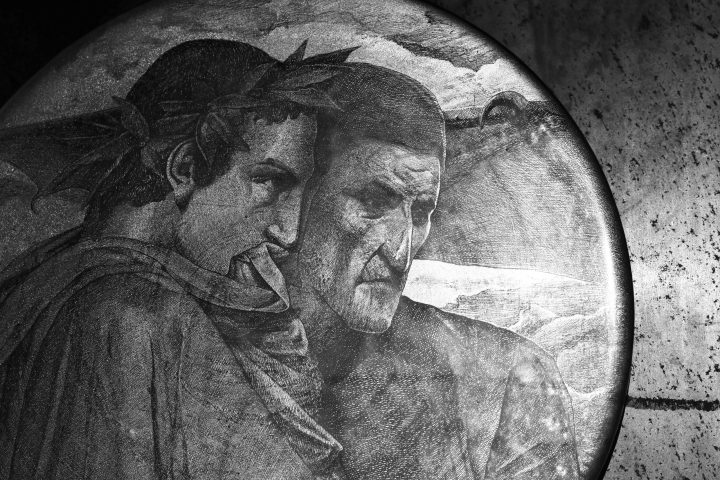
Dante and Virgil, detail from Hell 1953, 2025-26 – one of the eight medallions in gold glass etched by Riccardo Toso Borella, B&W photo
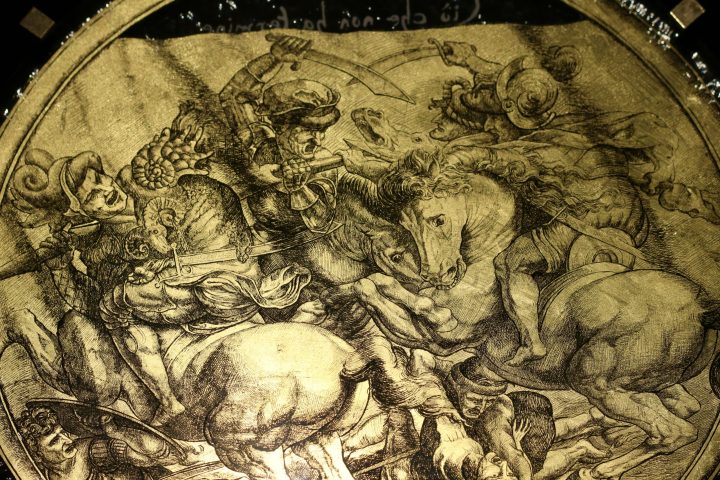
Detail from Seek Find, 2024 – artwork in gold glass etched by Riccardo Toso Borella
Using gold glass a medium to convey a message
Creating icons of modern Venice and Venetians in gold glass is for Riccardo Toso Borella a way to connect to the past times and keep a (family-rooted) tradition alive. At the same time, the projects he works at disconnect him from that ancient era, in that they relate to nowadays, a city of glass and gold still shining with its unexpected and contradictory nature.
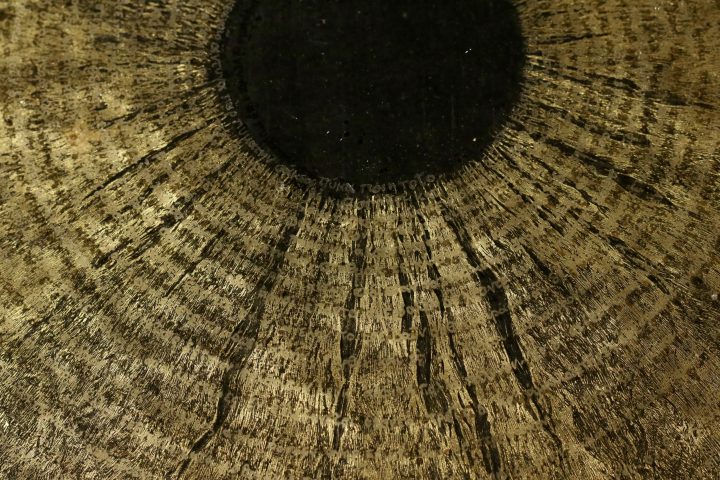
Detail of Hephaestus’ Will (provisional title), work in progress by Riccardo Toso Borella – the ancient Greek verses describing the shields, engraved on the glass, spiral towards the iris etched in the gold on the back of the glass, Venice; the iris is the artist’s own and being two pieces, they have been planned to reflect both eyes, in a specular way
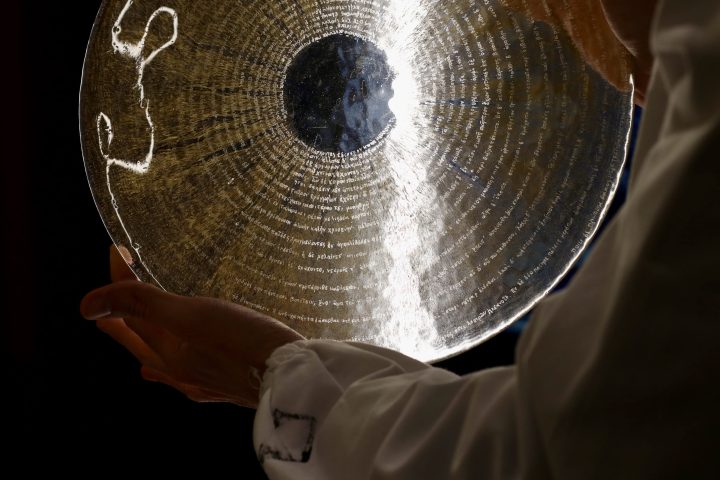
Backlight view of Hephaestus’ Will (provisional title), work in progress by Riccardo Toso Borella, Venice
by Luisella Romeo
registered tourist guide in Venice, Italy
www.seevenice.it