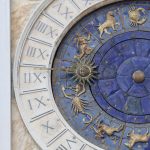
Ancient public clocks in Venice are present in different strategic places in Venice.
You will admire the prestigious “Torre dell’orologio”, clock tower, also known as the Tower of the Moors in St Mark’s square. Then you find a huge clock in the main square of Rialto, Campo San Giacometto, placed on the façade of the church of San Giacometto. You will also see a small one, but very visible, at the tower of the Arsenale, the ancient shipyard of Venice.
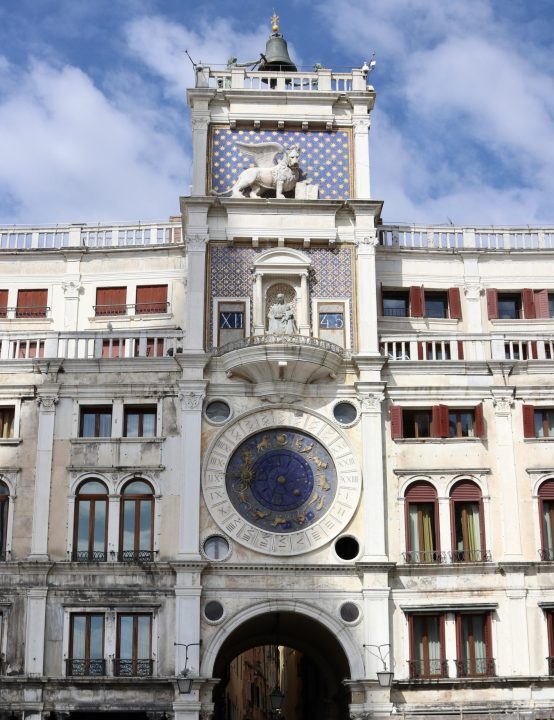
Clock Tower, end of the 15th century, Venice
More public clocks are inside the Doge’s Palace —in the Collegio and the Senate halls, in the Avogadori di Comun room.
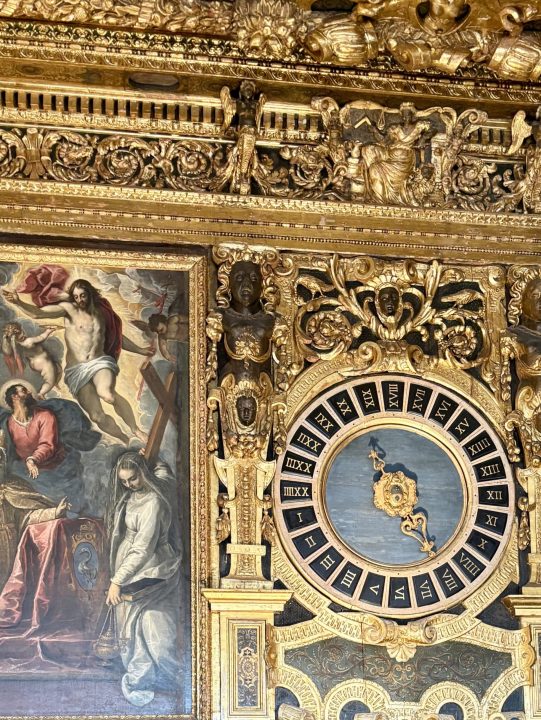
Senate Hall in the Doge’s palace, Clock with counterclockwise movement (imitation of the sun dial?), late 16th century, Venice
A monumental clock is also to be found inside the gothic Dominican basilica of Santi Giovanni e Paolo in Castello. On the bell tower of Campo Santi Apostoli you will find another one, beautifully shimmering in gold leaf. Another public clock is also placed on the bell tower of the Greek Orthodox Church of San Giorgio dei Greci: just, in this case, your attention will be rather drawn by the leaning tower 🙂
Bell towers in Venice did not tell what time was
Apropos, you will also find many bell towers, but bells were not tolling to tell you what time it was. They would communicate the liturgical schedule to invite the community to participate. Not to mention they would also function as watch guard towers. Or give alert signals regarding processions, public festivities or fires.
Were there more public clocks in Venice than we can see today? Yes. In 1601 there were around 27 public clocks in Venice. Have they been modified throughout the centuries? Oh, yes. Most importantly, though, they had different roles according to where they were placed and when they were made.
Different roles of public clocks in Venice
If clocks placed within churches or nearby would connect to the activity of a monastery, dividing the day accordingly to the different prayers —not just for the clergy—, clocks placed in Rialto by Campo San Giacometto and St Mark’s square had a different purpose and complexity.
The clock of San Giacometto church in Rialto
In Rialto, time was not regulated by devotional needs. A clock in Rialto had to be precise and it would establish and define time for the ones working, artisans, financial operators and merchants. The end of the day was sunset when darkness would create insecurity and chances for illegal commerce. This is what the clock on the San Giacometto church had to show.
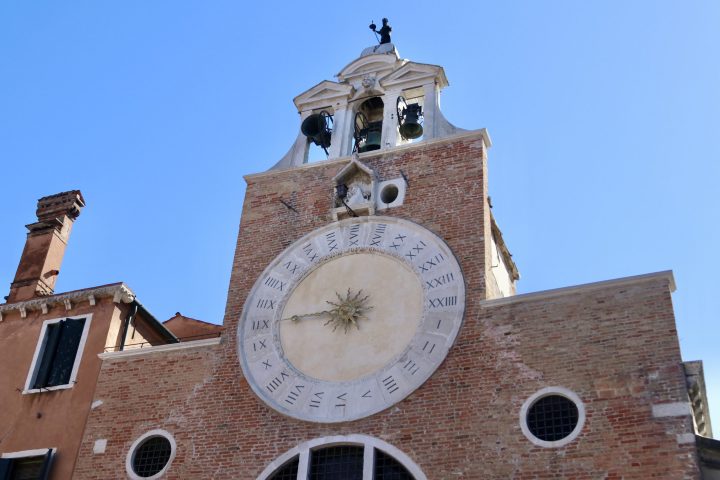
San Giacometto Church façade and its current clock, Venice
Not just.
As a matter of fact, there were two major public clocks in Rialto.
The clock of San Giovanni Elemosinario bell tower
A complex one, using two automatons, was placed by the church of San Giovanni Elemosinario by the Ruga Rialto. According to documents, it was indeed quite spectacular and, until the fire destroying Rialto in 1514, it attracted much attention. In the end, the sound message regarding time had been translated into a visual performance. Fun.
Marin Sanudo in his chronicle of the early 1500s wrote:
et cussì suonano le hore che è bello a veder.
(And so the hours sound that it is beautiful to watch)
Venetian hours at the church of San Giacometto in Rialto
It is only after the fire that the clock at San Giacometto started playing the main protagonist’s role in Rialto. At that time, it would show 24 hours with the number 12 where in our clocks you see the number 9 and with the number 24 where in our modern clocks you see the number 3. This is what one calls “Venetian hours”. The number 24 coincided with sunset and the number 1 was the first hour of the new day. This means, the new day would start after sunset and it would change every day.
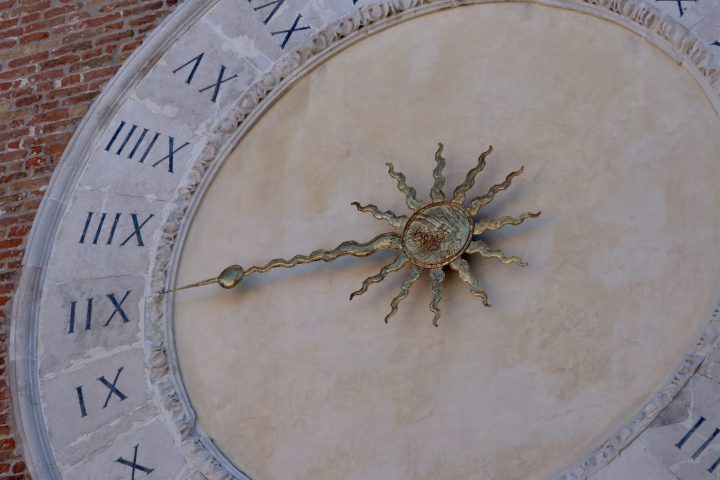
Detail of San Giacometto Church façade and its current clock, Venice
French hours or our current system
It took time to switch to our current system imported from France. Venice gradually adopted the French system. It became the official system only when general Bonaparte put an end to the Doge’s Republic in 1797. French hours feature 12 hours and no longer use sunset time as the end of the day. Tuscany, Milan, Genoa had adopted the French hours before.
The clock of San Giacometto, as we see it today, dates back to 1933 when it was last restored. However, it is very similar to what Canaletto would admire at his time. In the center we see the sun (and not the Earth as it was before Copernicus) and the juxtaposition between 12 and 24 reminds us of the sun’s movement from sunrise to sunset.
A confusing coexistence of clocks systems to calculate time
However, according to a recent publication by Francesco Zane, in this particular painting by Canaletto at the Gemäldegalerie in Dresden (1725-26), studying the shadows, Zane states that the clock shows that it was already working with the French system and that is long before the fall of the Republic… I wonder why. Was this clock showing the French hour on a 24-hour clock because Rialto was an international trade center and needed to be understood by foreign merchants…?
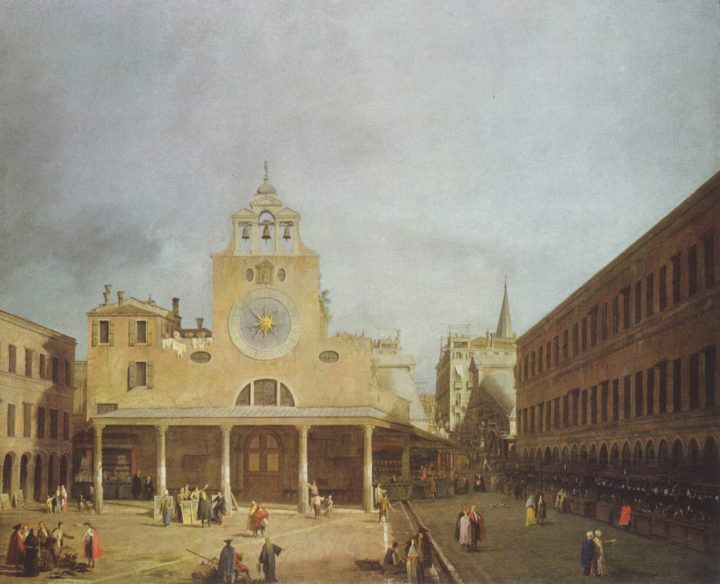
Antonio Canal called Canaletto, Campo San Giacometto in Venice, Gemäldeglaerie Dresden, 1725-26
The Clock Tower in St Mark’s square
In 1499 the Clock Tower in St Mark’s square was inaugurated. I was once told, it is not a clock tower, it is a clock in a tower. Indeed. This is for sure the most visibile of the ancient public clocks in Venice.
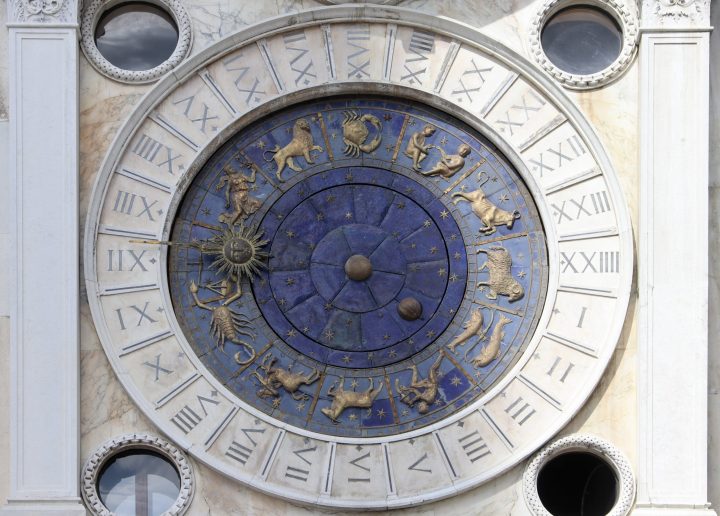
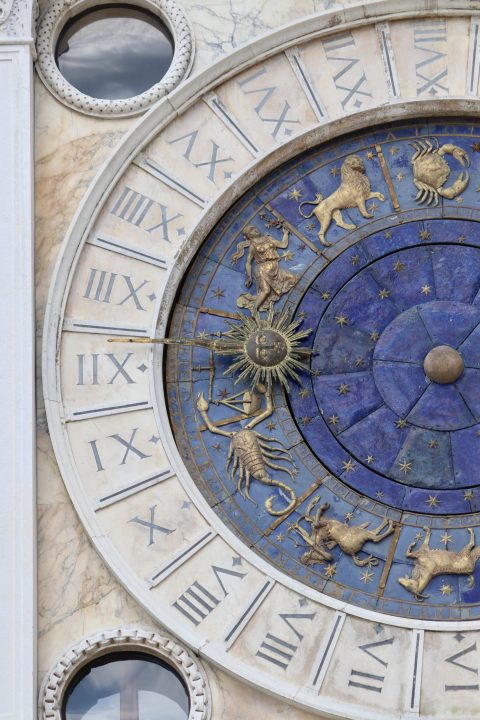
Time, astrological signs, moon phases: all details of the Clock Tower, end of the 15th century, Venice
A triumphal arch below turned this gigantic machine into a landmark to connect St Mark’s square, the government center, with the Rialto financial and trade center via the Mercerie street.
Again, as by campo San Giacometto in Rialto, the traditional elements are present: 24 hours, Venetian hours, sunset as the end of the day, number 12 positioned to the left where number 9 usually is and two bronze automatons on the top striking the hour. The sun still revolves around the earth (as originally the one in Rialto also was) and the Three Magi kneel in front of the Virgin Mary and child on Ascension festivity (and later on also on Epiphany).
Presence of planets and stars in public clocks in Venice
The novelty was the presence of astrological signs and moon phases revolving on a blue enameled background with golden stars. Originally the clock would also show the movements of the planets Saturn, Jupiter, Mars, Venus and Mercury.
In Venice we can admire two other clocks with such a precise focus on astronomy. One is in the Senate Hall of the Doge’s palace. The other one is inside the Basilica of Santi Giovanni e Paolo, the pantheon of the Doges, governed by educated Dominicans.
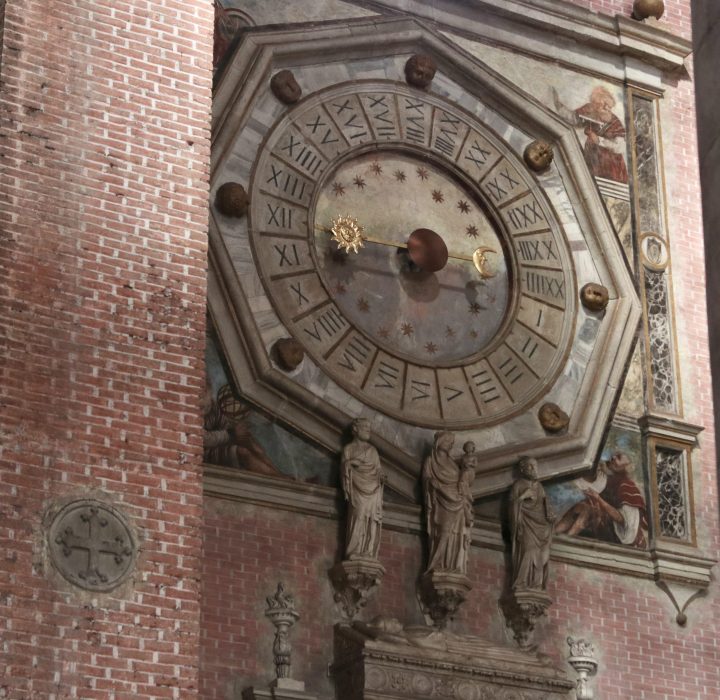
Basilica of St John and St Paul (San Giovanni e Paolo), monumental clock, 16th century, Venice
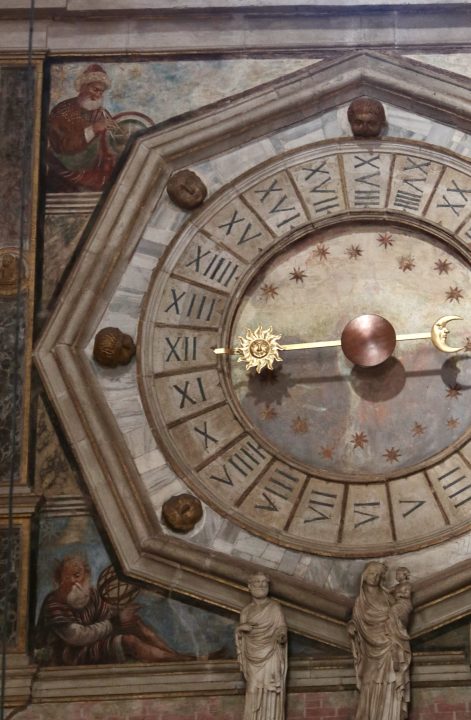
Detail of the monumental clock in the Basilica of St John and St Paul (San Giovanni e Paolo), 16th century, Venice
Strangely enough, no such clocks would be in other cities governed by the Doges, except the university city of Padua, where the clock tower is also older than the one in Venice.
Personally, I tend to think this clock had more to tell than time for politics. For sure, it defined a conflict with the time of the Church, just like the clock in Rialto. But there’s more and it is a clear celebration of the machine and technology. As sort of a triumph of the human kind, science and mechanics and the secular world. No more uncertainty.
A baroque clock in Santa Maria Gloriosa dei Frari Church
Fortunately, humans are also ironic and do not take themselves too seriously. We do falter. Just go and observe the clock by Francesco Pianta in the Frari church, of the middle of the 17th century.
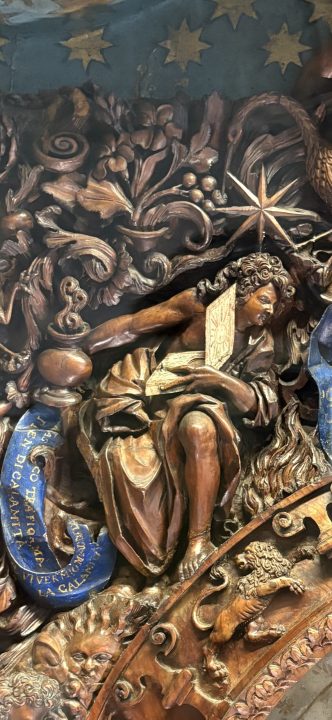
Detail of time allegory in the clock by Francesco Pianta, 17th century, Frari church, Venice
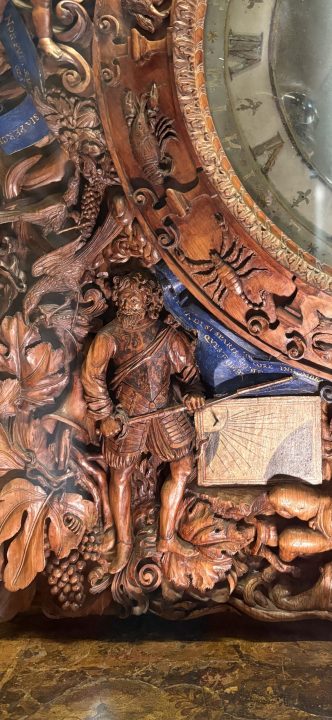
Sun dial detail allegory in the clock by Francesco Pianta, 17th century, Frari church, Venice
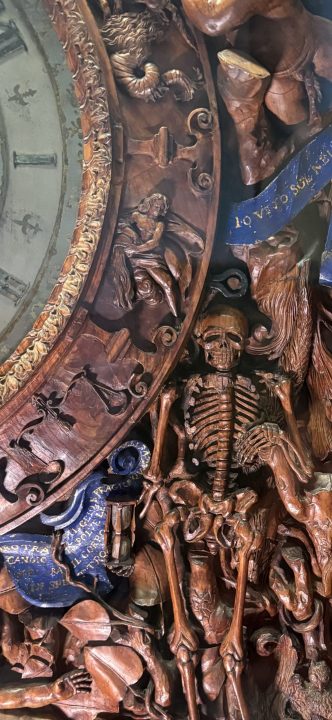
Skeleton allegory in the clock by Francesco Pianta, 17th century, Frari church, Venice
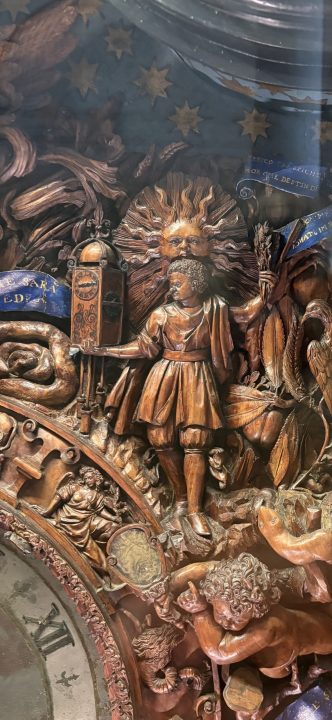
Tower clock detail in the clock by Francesco Pianta, 17th century, Frari church, Venice
While exploring all possible symbols of time carved in the wood, starting with Cronus, the astrological signs, the hour clock, etc. you finally realize the clock background is a mirror.
You watch yourself, therefore, growing older and older. So you end up wondering if you then really think you know what time is, or if instead all you know is that time flies, it is always late, just like in the words of the White Rabbit running in Alice in the Wonderland.
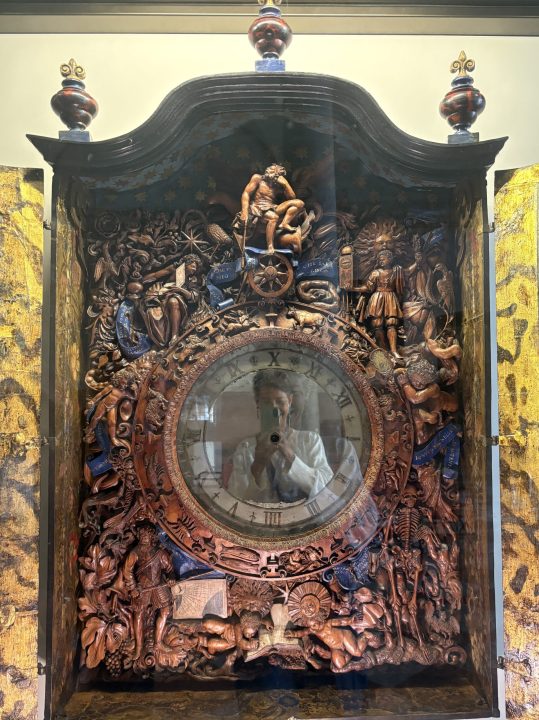
Reflection of myself on the clock by Francesco Pianta, 17th century, Frari church, Venice
by Luisella Romeo
registered tourist guide in Venice, Italy
www.seevenice.it