Gardens in Venice are quite amazing. As I had a chance to explain in a previous post, the lagoon conditions are quite prohibitive for (certain) plants.
The presence of brackish water (and lack of fresh water until the construction of the aqueduct in 1885), the rise in the sea level, the strong wind striking the lagoon islands brought Venetians of the past to design gardens and orchards so to protect vegetation from the lagoon environment. So here we are: high brick walls, soil reclamation, importing fertile soil to lay on top of autoctone soil, gates and dams to control tidal flow: there is nothing natural about Venetian gardens and orchards.
We can almost say Venetian gardens and orchards are the result of a conflict between humans and the unfriendliness of a dynamic lagoon nature, i.e. an act of force responding to the human need for food and green beauty.
But, without human intervention, would the lagoon be completely bare? Wouldn’t there be any plant?
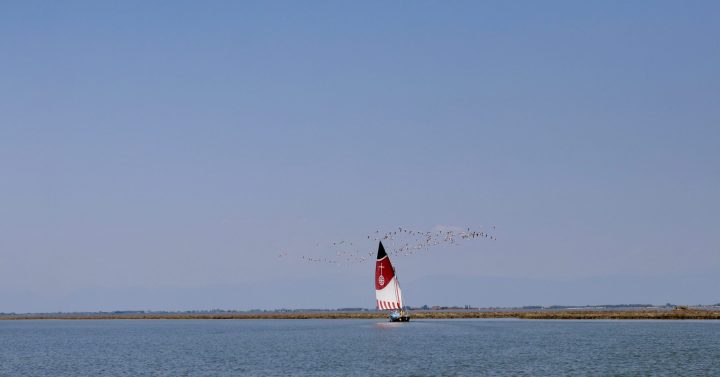
Maistral, a Venetian boat dating back to 1967, sailing in the northern lagoon by Lio Maggiore with a flock of flamingoes flying above, August 2026
Plants of the Venetian lagoon: salt tolerant species
During my usual summer exploration of the Venetian lagoon with my sailboat Còcola this year, I was really surprised by the variety of plants and flowers growing in the mudflats. The autoctone plants. Well, by the way, you don’t need a sailboat, a kayak will also do or even a bicycle, all you need is to move slow otherwise it is hard to observe the miracle of lagoon nature.
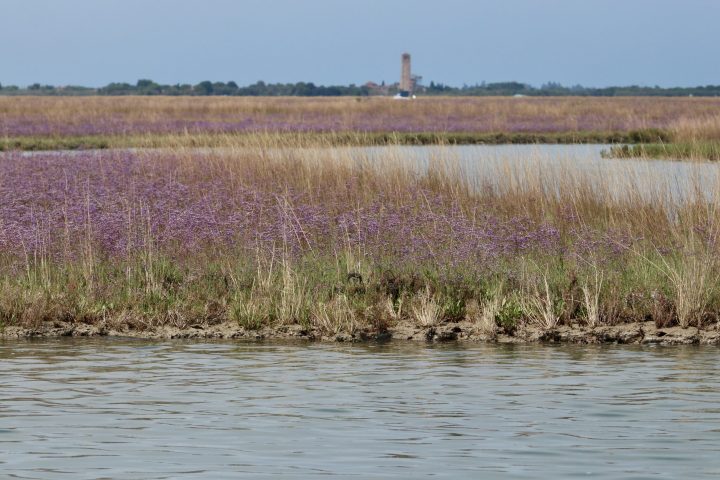
Blooming limonium in the Venetian lagoon, view of Torcello bell tower in the distance, August 2025
Climate change in the lagoon
We were saying, variety of plants and flowers… Maybe I should also add that this summer has been particularly hot. For several days in a row, in July and August, there was no rain and high temperatures (degrees around 35-36 celsius) have affected Venice and its lagoon. Climate scholars claim this is going to be usual and this summer has likely been much cooler than future ones.
Grapes are picked up a couple of weeks before the usual season. Figs are already mature by early August, while they used to ripe in mid September. You still swim at the Lido, but trees show yellow leaves as if it were already autumn.
And yet, the margins of the canals in the northern lagoon were covered in beautiful vegetation, suffering but alive.
Some plants you can see when exploring the lagoon in a slow mode
In particular, you could find plenty of “salicornia veneta”, perennial glasswort in English. This halophyte plant, salt tolerant, is typically looking like a succulent plant and in the summer its color is green.
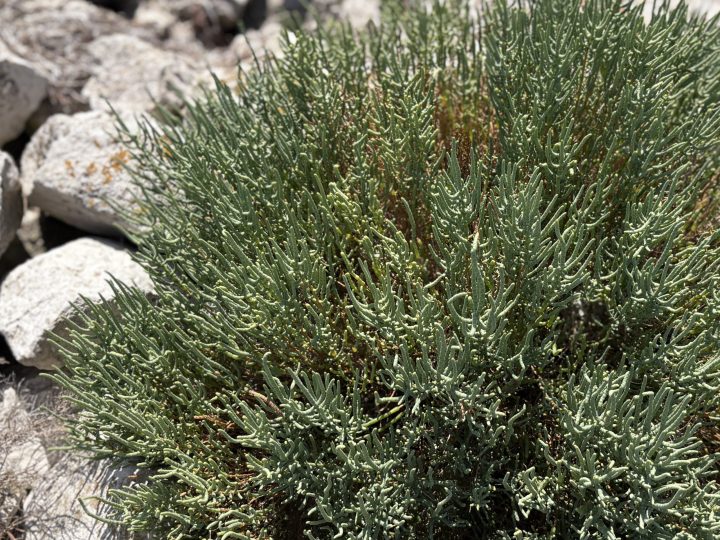
Salicornia veneta, marsh samphire or sea asparagus in English, Venice lagoon by Lio Piccolo 2026
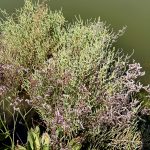
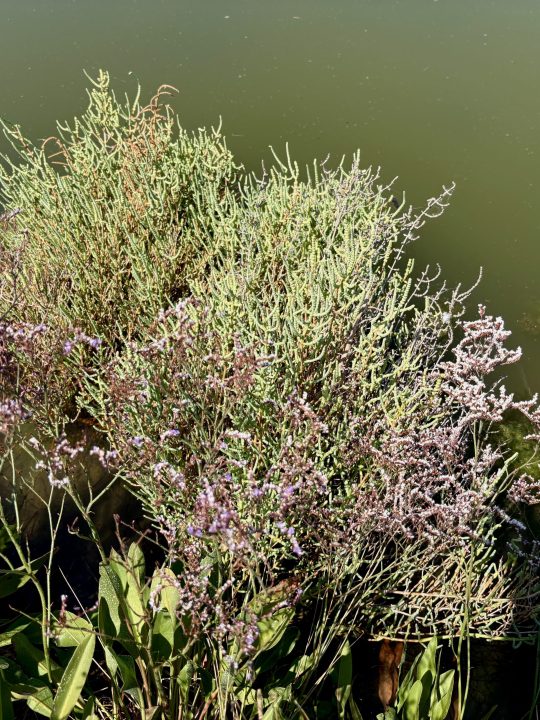
Nearby, all burnt in the sun, the “limonium serotinum” was less purple than I remember last years. Limonium, also known as sea lavender, is characterized by tiny little flowers of the color of heather and it covers mudflats in the northern lagoon of Venice, creating wonderful shades mixed with green and blue water. Also tamarisk trees have a similar color when their tiny, thin needle-like leaves bloom.
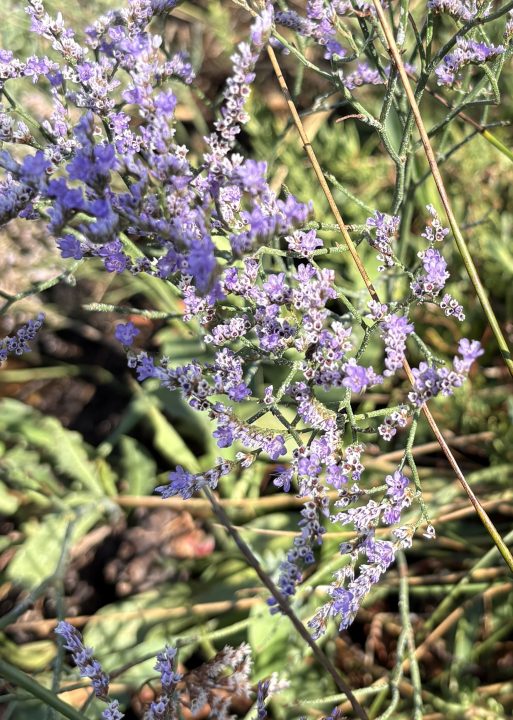
Limonium (Limonium serotinum), Venice lagoon by Lio Piccolo 2026
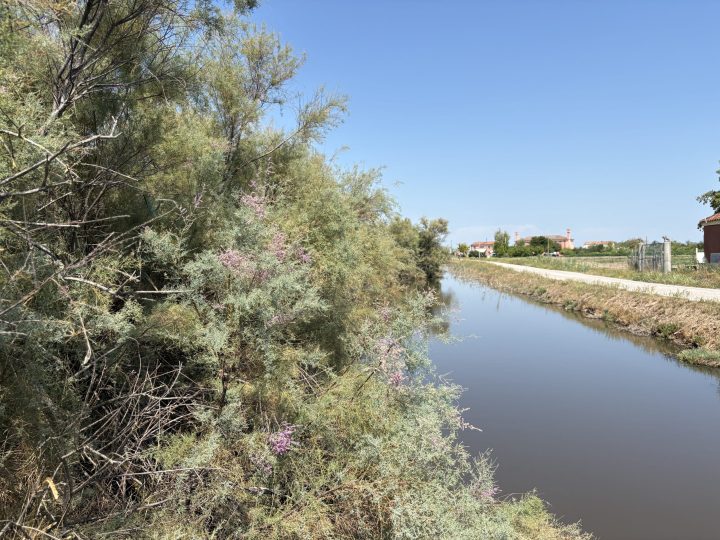
Tamarisk tree by the Agriturismo Le Saline, Lio Piccolo 2026
I happened to also find some yellow flowers, the “Inula crithmoides”, golden samphire, showing their seed heads, already light brown in the heat. Contrasting with the purple limonium, it was really a wonderful palette.
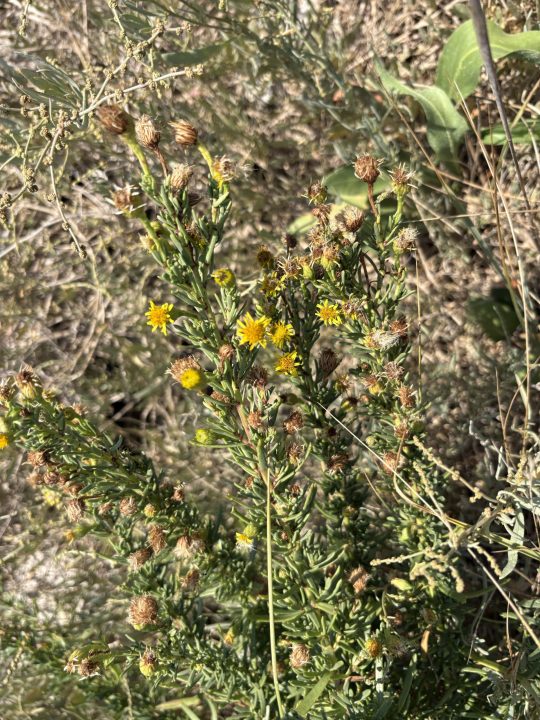
Inula crithmoides, Venice lagoon by Lio Piccolo 2026
Not to mention the delicate funnel-shaped flowers in pale pink of the “convolvulus arvensis”.
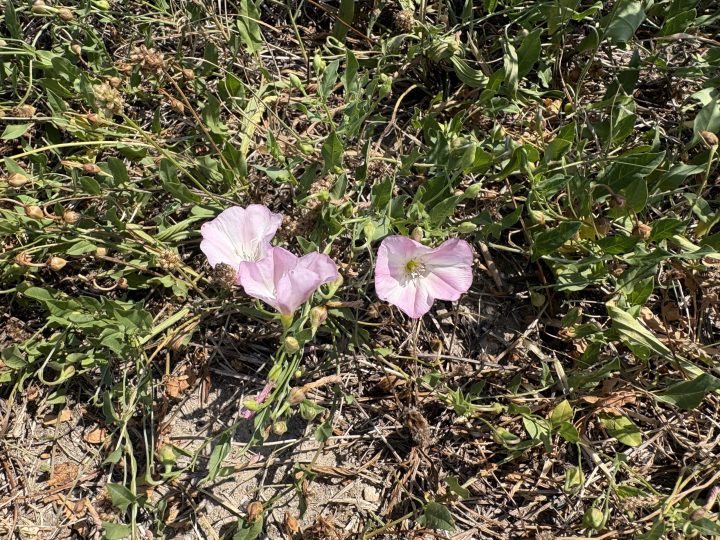
Convolvulus arvensis, Venice lagoon by Lio Piccolo 2026
Or the silver green leaves of the “Halimione portulacoides”, commonly known as sea purslane. Or finally the violet sea aster “tripolium pannonicum”.
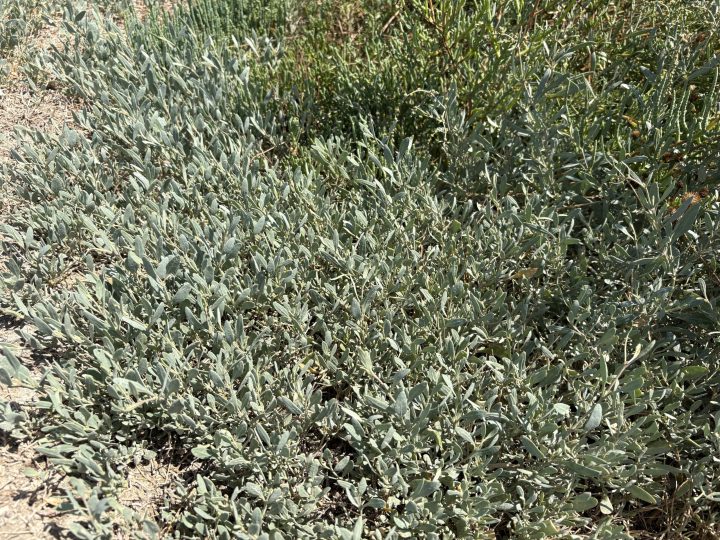
Atriplice Portulacoide (Halimione portulacoides), Venice lagoon by Lio Piccolo 2026
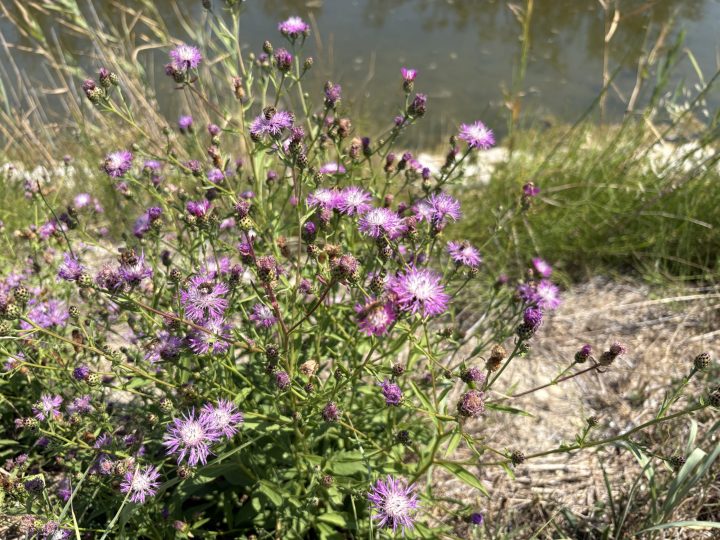
Violet sea aster “tripolium pannonicum”, Venice lagoon by Lio Piccolo 2026
As I could not find any “santonego” (sagebrush in English), I got happy with the grappa flavored with this plant from the Agriturismo Le Saline, always a great place where to stop for some lunch or dinner with local food…
Plants in the Venetian lagoon with little consideration
There would be much more to tell about these brave plants, thriving in a peculiar environment as the Venetian lagoon. Funny thing is that in Venetian gardens designed by famous landscape architects these plants are not taken into consideration. The reason why this happens is to me unclear. Are they too invasive? Or are they simply treated as “weeds” and therefore not decorative?
Venetian cuisine and salt tolerant plants
I was surprised to read these plants do not feature in any culinary tradition in Venice, either. When you read Venetians made great use of another typical halophyte plant, the “salsola amaranthacea”, for instance, well, the plant was important as it contains large quantities of soda ash, working beautifully to blow Murano glass. These plants therefore have always been known, but they never entered a kitchen.
Chiara Pavan and her “environmental cuisine” at Venissa
This summer I enjoyed reading the book by Chiara Pavan (in Italian edited by Mondadori) entitled “Cucina ambientale”, environmental cuisine. For the ones in love with food and its secrets, the name of Chiara Pavan is quite well known. Pavan is the chef at Venissa, a Michelin restaurant on the island of Mazzorbo, near Burano.
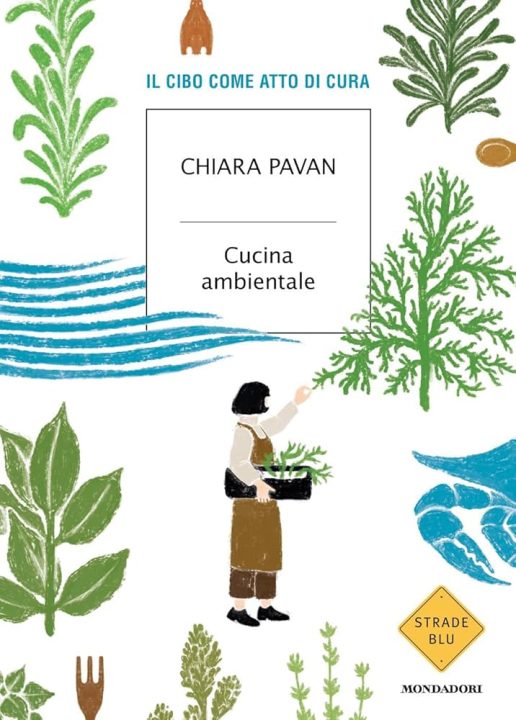
Cover page of Cucina Ambientale by Chiara Pavan, ed. Mondadori, 2026
Her book relates her story and also reveals her respectful approach towards the lagoon. In her words, one needs to be “environmentally responsible” even in the kitchen when we prepare food. Facing climate change and its consequences in the Venetian lagoon —some species started disappearing, such as soft shell crabs—, the arrival of “alien” species, as the blue crab, Chiara Pavan searches for ways to turn a disadvantage into an opportunity. If sticking to the traditional cuisine affects the environment, she adds, then why not starting to consider new ingredients connected to the local environment which however did not feature in the traditional Venetian cuisine? In other words, are there ways to take care of the environment while we cook (or eat) and are there ways to create a new cuisine when sticking to the tradition means to have negative effects in the lagoon environment?
Plants of the Venetian lagoon then appear in this new trend. Chefs can be pioneers discovering new flavors, adapting themselves in a creative way to the changing lagoon environment.
The “Tidal Garden”, a laboratory by Lorenzo Barbasetti di Prun
Chiara Pavan also mentions the project “Tidal Garden” promoted by Lorenzo Barbasetti di Prun. Barbasetti di Prun is also a chef, cofounder of prometheus_open food lab where cuisine, art and ecology are strictly interrelated. You can follow the project here: www.instagram.com/prometheus_lab/
So we learn that these lagoon plants are not just part of this new cuisine, but they are quite a protagonist. And not just local plants, but also small local producers and farmers get involved, thus fostering a different economy. When reading about the Tidal Garden project, I was particularly struck by one aspect: bare soils could turn into interesting soils if you grow halophyte plants which love them. Just, we have to learn to appreciate them and stop ignoring them.
by Luisella Romeo
registered tourist guide in Venice, Italy
www.seevenice.it
Special thanks to Barbara Boifava whose passion for these flowers and plants has opened my eyes to their special beauty